

⚡ QUICK SUMMARY
Humidity control means managing indoor moisture so a building stays comfortable, healthier, and structurally stable — not just cooler. It sits right at the intersection of indoor air quality, thermal comfort, ventilation, and building durability.
• What it is: keeping indoor relative humidity in a moderate band, so air is neither too damp nor too dry
• Why it matters: high humidity drives condensation, musty odors, and mold risk; low humidity feels dry and irritating
• How it works: measure moisture in the right zones, control the source (ventilation, dehumidification, outdoor-air treatment), and keep it stable over time
• Where it counts most: hotels, offices, schools, clinics, and any building in a hot, humid climate or with a mold history
Why it matters: Cooling alone does not fix humidity. Buildings feel, perform, and age far better when moisture is measured and actively controlled.
Humidity problems rarely announce themselves in a neat technical way.
They show up as sticky rooms, condensation on glass, musty smells, complaints about stuffy air, mold spots in hidden corners, or spaces that feel uncomfortable even when the thermostat says the temperature is fine. That is why humidity control matters more than many building teams expect.
In simple terms, humidity control means managing indoor moisture levels so a building stays comfortable, healthier, and operationally stable. In real buildings, that usually means preventing air from becoming too damp or too dry, and making sure HVAC and ventilation systems respond properly to the moisture load in the space.
It sounds simple. In practice, it sits right at the intersection of IAQ monitoring, thermal comfort, ventilation, and building durability.
It is not just about comfort
This is the first thing worth clearing up.
A lot of people think humidity is mainly a comfort issue. It is true that humidity affects how a space feels, but the real picture is bigger than that.
When humidity is too high, buildings become more vulnerable to condensation, damp smells, microbial growth, and hidden moisture problems. When it is too low, spaces can feel dry, irritating, and harder to tolerate over time. So humidity control is not only about making the air feel better. It is also about protecting the building, supporting indoor-air quality, and helping the HVAC system behave more predictably.
That is why humidity control should not be treated as a minor side setting inside the HVAC system. In many buildings, it is a core operating condition.
Why humidity matters in real buildings
Humidity becomes especially important when one or more of these are true:
- occupancy changes a lot during the day
- outdoor air is hot and humid
- the building has high ventilation loads
- the space is densely occupied
- there are kitchens, showers, pools, or wet processes nearby
- the building struggles with mold, odors, or condensation
- comfort complaints continue even when temperature looks normal
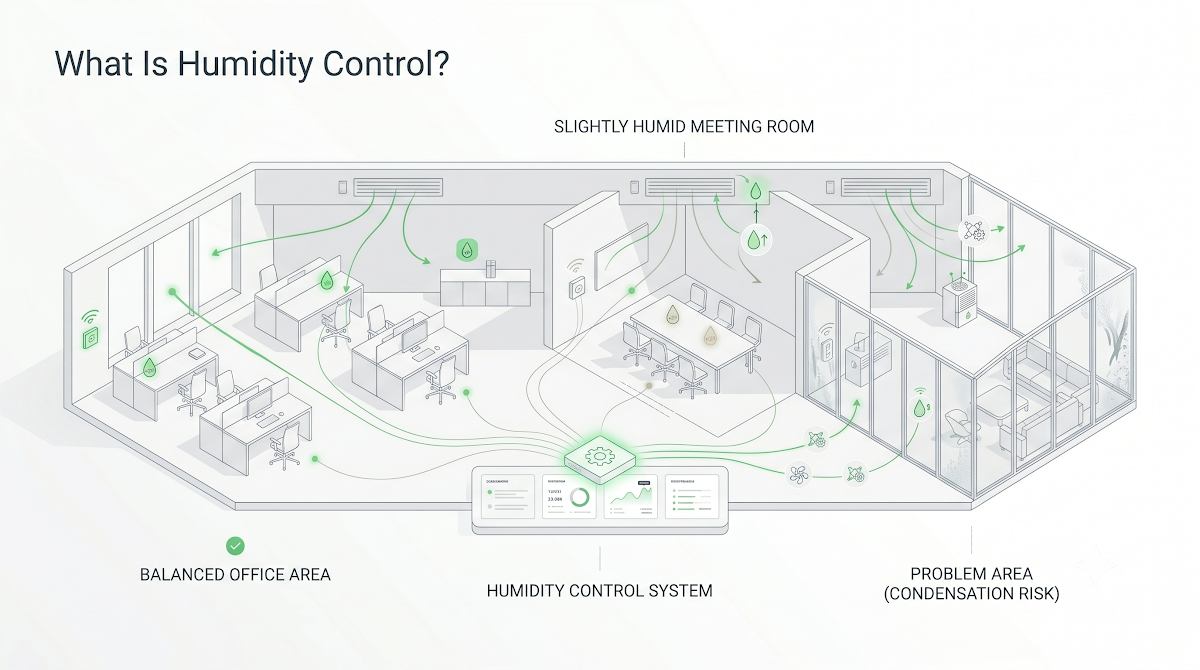
This is why the topic becomes very practical in hotels, offices, schools, clinics, gyms, and mixed-use buildings. A meeting room may overheat partly because the moisture load rises with occupancy. A hotel room may feel clammy even when cooling is active. A lobby may feel heavy because outdoor-air treatment is not doing enough latent work.
In those buildings, humidity is not an abstract engineering parameter. It is part of the day-to-day experience of the space.
What humidity control actually means in practice
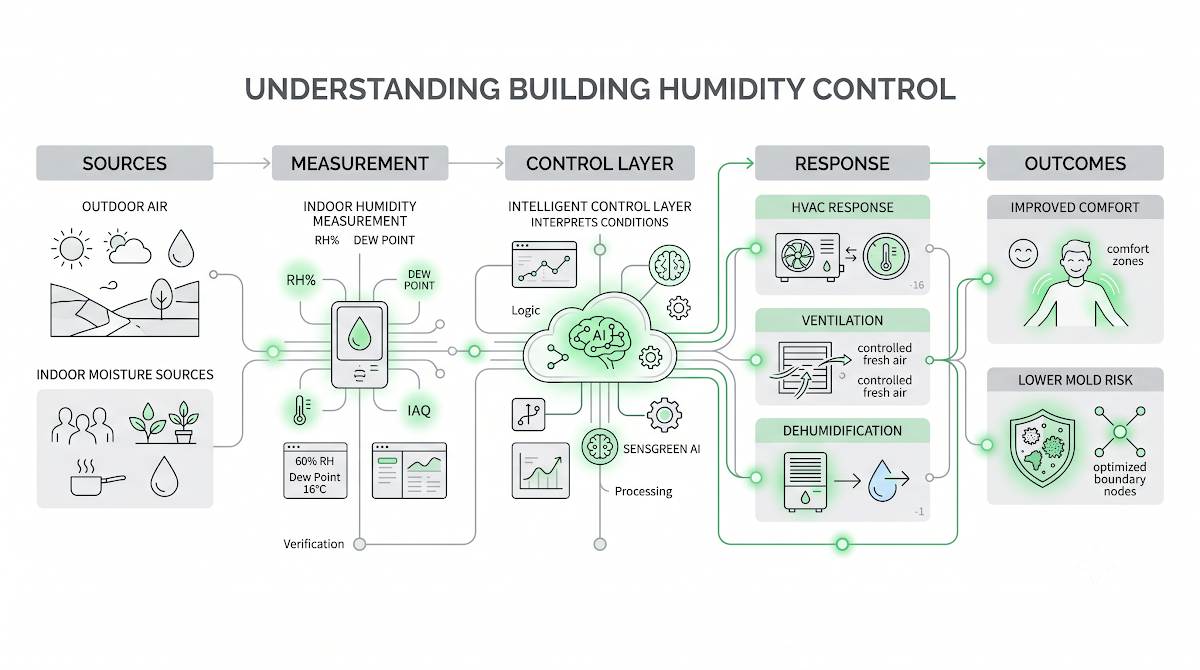
A good humidity-control strategy usually does three things.
1. It measures moisture conditions properly
This starts with sensors. If a building is not measuring humidity in the right spaces, it is mostly guessing.
2. It controls the source of moisture
That may mean better ventilation logic, dehumidification, outdoor-air treatment, fixing infiltration, or reducing moisture generation in certain spaces.
3. It keeps the system stable over time
This is where humidity control becomes an operational issue. The building needs to hold indoor moisture in a sensible range across different weather conditions, occupancy patterns, and daily operating modes.
That is why humidity control is not only a mechanical issue. It is also a control issue.
What good humidity control looks like now
The better projects usually take a broader view.
They do not look at humidity in isolation. They treat it as part of the overall indoor-environment picture, together with temperature, ventilation, occupancy, and sometimes particulate matter or VOC behavior.
They also understand that the “right” humidity condition depends on context. In some spaces, the real priority is mold prevention. In others, it is occupant comfort. In some buildings, it is protecting finishes, equipment, or building fabric. In others, it is stabilizing the effect of ventilation air in hot or humid weather.
That is why modern humidity control works best when it is tied into the wider IAQ monitoring layer rather than treated like a hidden HVAC variable.
The common target range problem
This is where a lot of content on humidity becomes too simplistic.
People often want one perfect number. Real buildings do not work like that.
A more practical approach is to think in ranges and guardrails:
- too high, and the building starts moving toward mold risk, condensation, and clammy discomfort
- too low, and spaces can start to feel dry and irritating
- in the middle, humidity supports comfort and helps reduce moisture-related problems
For most normal indoor environments, the practical target is usually to keep indoor relative humidity in a moderate band rather than constantly chasing one exact figure. In real operations, trends matter more than a single reading. A room that briefly rises is different from a building that stays chronically damp.
Why humidity control is especially important in hot and humid climates
This is where the topic becomes even more operationally important.
In warm and humid climates, outdoor air can bring a large latent load into the building. That means the HVAC system is not only cooling air. It is also trying to remove moisture. If that moisture load is not handled well, the building may feel uncomfortable even when supply air is cold.
This is one reason some buildings feel “cold but still humid.” The system is delivering sensible cooling, but latent control is not keeping up.
That is also why humidity control needs to be part of ventilation strategy, not just room cooling. In many spaces, outdoor air is one of the main ways moisture enters the building, so humidity control depends heavily on how that outdoor air is treated.
What humidity control looks like in real use cases
Offices
In offices, humidity problems usually show up as stuffy air, comfort complaints, or afternoon discomfort that people often blame only on temperature. But in reality, humidity and ventilation can be part of the issue too.
Hotels
Hotels are one of the strongest examples. Guest rooms can feel damp after showering, when balcony doors stay open, or when the HVAC system is not managing latent load properly. Public spaces like lobbies, breakfast rooms, and gyms can also see major humidity swings with changing use.
Schools and meeting rooms
In densely occupied spaces, moisture rises along with CO2 and heat load. That is why humidity often overlaps operationally with ventilation control.
Buildings with mold history
If a building has had repeated dampness, musty odor, or condensation issues, humidity control should be treated as a core performance topic, not a cosmetic one. This is where mold prevention and humidity strategy come together. See how teams tackle this in Combating Mold in Buildings with IoT Technology.
Where teams usually get it wrong
The same mistakes come up again and again.
Treating humidity as a secondary metric
If teams only look at temperature, they miss a big part of how a space actually feels and behaves.
Assuming cooling automatically solves humidity
It often helps, but not always enough. A building can be cool and still feel damp.
Ignoring outdoor-air moisture
This is especially important in humid climates. Bringing in outside air without handling the moisture properly can create comfort and mold problems fast.
Measuring too little
If the building has no humidity visibility in the right zones, operators are mostly working blind.
Not connecting humidity to action
A humidity reading is useful only if it leads to better control decisions, better ventilation logic, or better operational response.
Why humidity control is becoming more important
Humidity is becoming more strategic because buildings are expected to do more at once.
- They need to be efficient.
- They need to be comfortable.
- They need to support health and wellness.
- They need to avoid mold risk and hidden building damage.
- And they need to do all of that across more variable occupancy and weather conditions.

That is why humidity control is no longer just a mechanical detail. It is part of the wider smart-building operating model.
And it is also why humidity sensing deserves a place in indoor-environment strategies rather than being ignored until something goes wrong. Sensgreen’s Indoor Air Quality Monitor makes that visibility practical.
Final thought
Humidity control is really about one thing: keeping indoor moisture in a range where people, systems, and spaces all work better.
That means better comfort. Better air quality context. Less mold risk. Less condensation. And a more stable indoor environment overall.
That is why humidity control matters. Not because relative humidity is a glamorous metric, but because buildings feel, perform, and age differently when moisture is not under control.
