

⚡ QUICK SUMMARY
AI in building operations is a decision layer that reads a building’s data and turns it into prioritized, explainable action — moving teams from passive monitoring to AI-guided, and eventually autonomous, operations.
• What it is: machine learning and analytics on top of your existing BMS, sensors and meters — not another dashboard
• The point: fewer, better decisions rather than more alarms; it tells you what matters first, and why
• How it works: Connect (BMS, wireless sensors, meters) → Understand (analytics, anomaly detection, root cause, predictive maintenance) → Act (setpoints, ranked alerts, reports, automation)
• Proof: ~12% energy saved on split AC in one deployment, ~30% lower maintenance cost, and manual reporting cut from hours to minutes across an 80-building Dubai portfolio
Why it matters: The buildings that win with AI are not the ones with the most technology — they are the ones where AI quietly removes friction from everyday operations. Best practice: sense first, automate later.
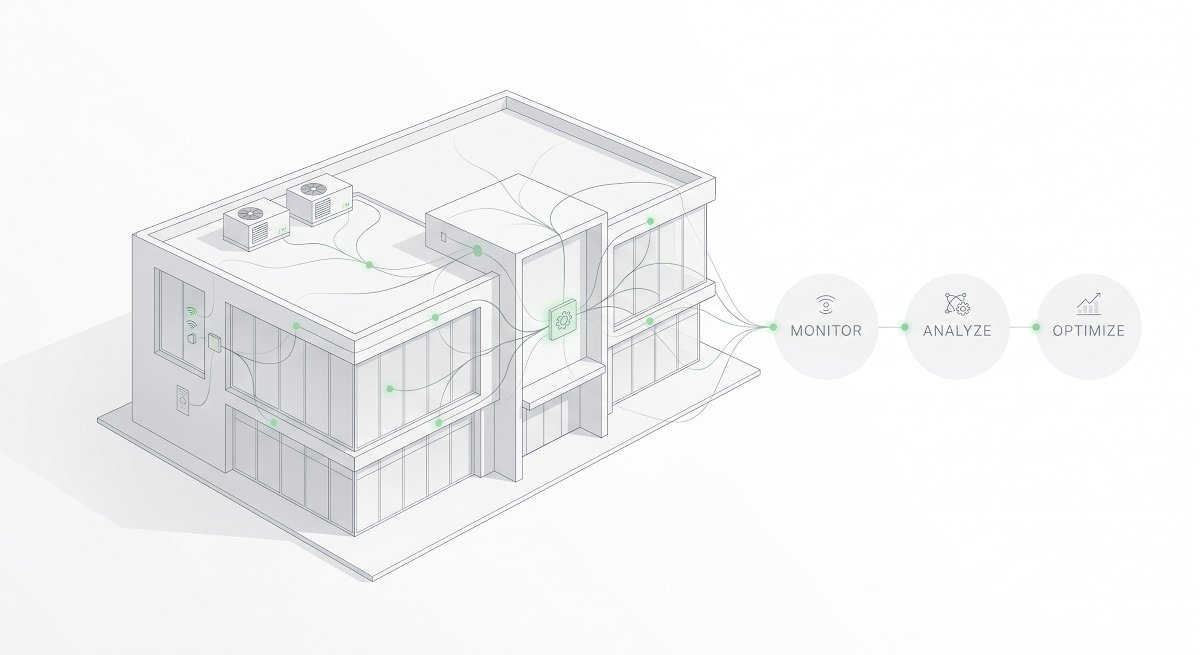
Most buildings today are not short on data. They are short on decisions.
Walk into almost any commercial building and you will find sensors, meters, a BMS, maybe a few dashboards. Information is everywhere. Yet the people running the building still spend their days reacting: chasing comfort complaints, clearing alarm floods, and finding out about a failing chiller only after a tenant calls.
That gap, between everything a building knows and what actually gets done about it, is the gap AI in building operations is meant to close.
This guide explains what that means in practice. Not the hype version, but the working version: what AI in building operations actually is, how it works, where it earns its keep, and where teams keep getting it wrong.
What AI in building operations really means
AI in building operations is the use of machine learning and data analytics to interpret a building’s data and turn it into prioritized, explainable action, instead of leaving operators to read raw numbers and decide everything manually.
It matters because buildings generate far more data than any team can watch, and most of that data never becomes a decision. AI sits on top of the existing stack as a decision layer: it reads what the building is doing, works out what is wrong and why, and recommends or triggers the fix.
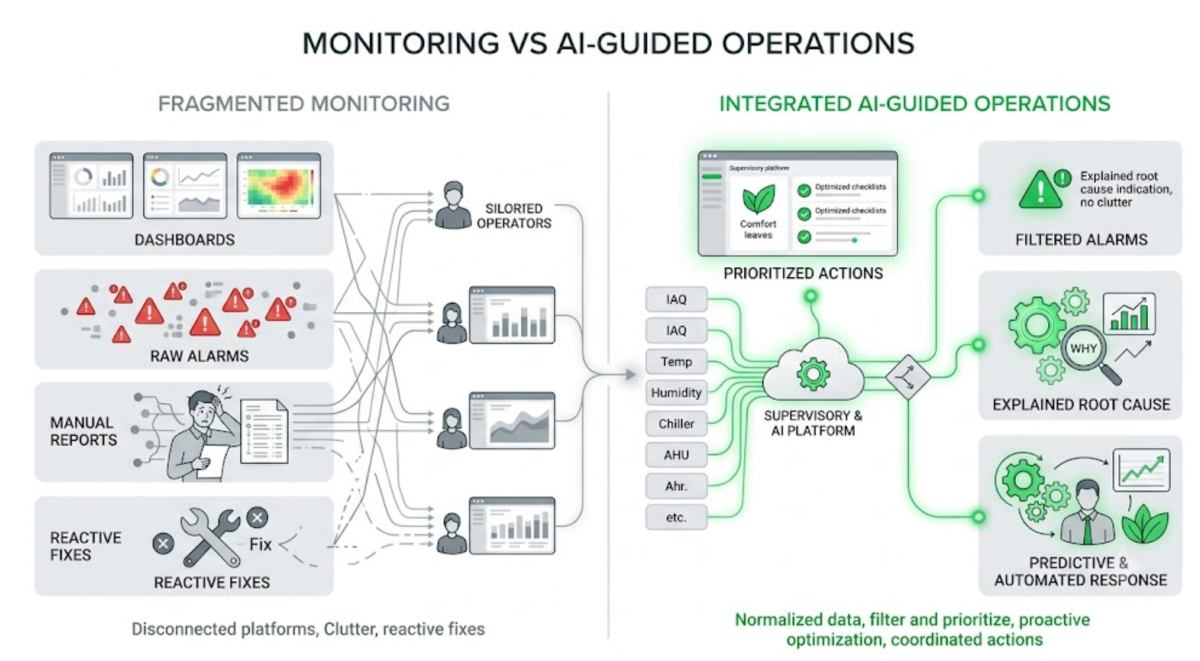
In day-to-day terms, it is what moves a building from “we have monitoring” to “we know what to do next.” That shift, from passive monitoring to AI-guided operations, is the real story of the last few years.
It is not just dashboards and alarms
This is the most common misunderstanding, so it is worth being blunt.
AI in building operations is not a prettier dashboard. A dashboard shows you the data and leaves the thinking to you. It is not a bigger pile of alarms either. More alarms usually make operations worse, not better.
The point of AI is the opposite of more information. It is fewer, better decisions. A good system reduces what a human has to look at, tells them what matters first, explains why, and ideally handles the routine cases on its own.
If a tool just adds another screen to check, it is monitoring with an AI label on it. Real operational AI changes what the team does on Monday morning.
Why it matters now
A few pressures have arrived at the same time, and together they make this practical rather than aspirational.
Operating cost pressure is constant, and HVAC and energy are the biggest controllable line items in most buildings. Teams are also leaner than the portfolios they manage, so the old model of one expert watching one building does not scale to fifty.
At the same time, comfort and air quality expectations have risen, regulations are tightening, and most of the building stock is older, fragmented, and never designed to be “smart.” Cloud and wireless retrofits finally make it cheap to get good data out of these buildings, which is exactly what AI needs to work.
Put simply: the data layer got affordable, the operational problems got harder, and AI became the only realistic way to manage both at portfolio scale.
How it works in practice
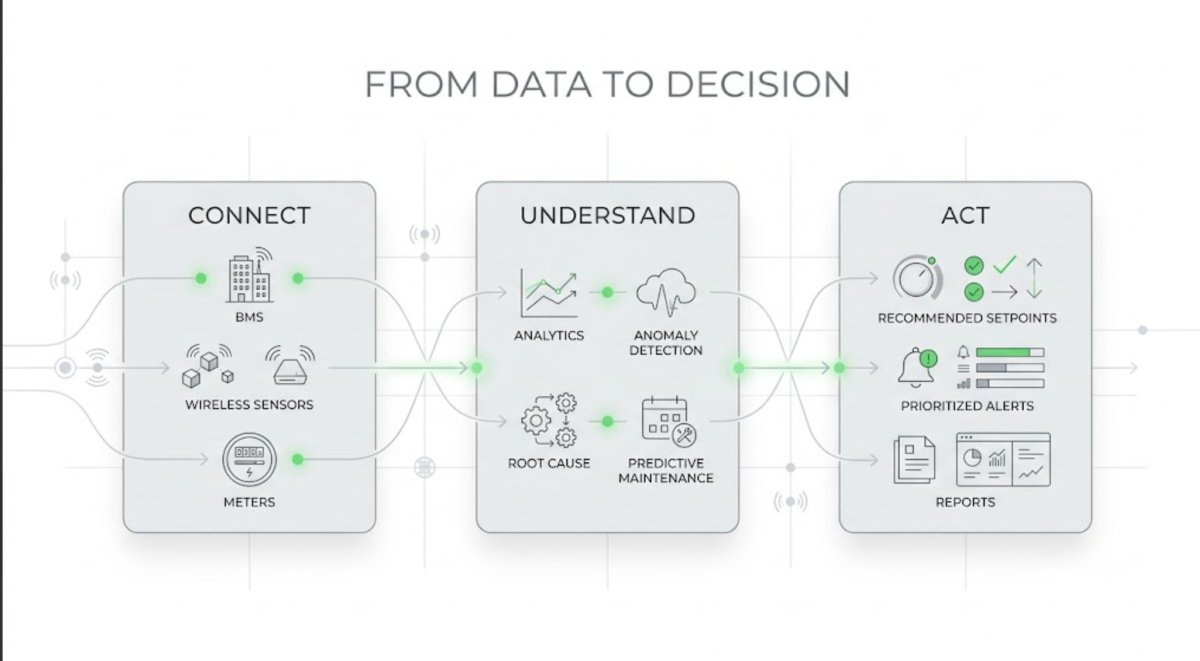
Underneath the marketing, operational AI follows a fairly consistent three-stage logic. It is useful to see the building’s data flow as Connect, Understand, Act.
1. Connect
First the system needs data. That means pulling from BMS points over protocols like BACnet, Modbus, and KNX, from wireless sensors on networks like LoRaWAN, and from existing energy meters. No clean data layer, no useful AI.
2. Understand
This is where the intelligence lives, and it is really several capabilities working together:
- Building analytics turns raw streams into patterns and context.
- Anomaly detection flags behavior that does not fit the building’s normal pattern, including subtle drift that no fixed threshold would catch.
- Root-cause logic explains the anomaly, for example spotting a “fighting loop” where heating and cooling run against each other in the same zone.
- Predictive maintenance uses condition trends to flag equipment likely to fail before it does.
3. Act
Insight only matters if it changes something. This stage produces recommended setpoints and schedules, real-time alerts that have already been filtered and ranked, and reports that are ready to share. The most advanced layer closes the loop and adjusts the building automatically, which is the road toward autonomous building operations.
Sit those three stages on top of an existing building and you have the operational decision layer.
What good practice looks like now
The stronger projects we see share a few habits, and they are mostly about discipline, not sophistication.
The best current approach is sense first. Build a reliable data layer, prove the insights are trustworthy, then expand into automated control. Teams that trust the AI to act before the data is clean almost always regret it.
Good implementations also judge the AI by one number: how fast it closes the gap between “something feels off” and “we fixed it.” Stronger systems explain every recommendation, so operators learn to trust them, and they keep a human in the loop for anything with comfort or safety stakes until confidence is earned.
And the better projects treat this as a portfolio method, not a hero project on one flagship building. A repeatable pattern across many sites beats a perfect deployment on one.
This is also where a dedicated engine matters. Pulling analytics, anomaly detection, and prioritized action into one place is exactly the job Sensgreen AI is built for, rather than bolting AI onto a single subsystem.
Real-building examples
The pattern shows up clearly in the field.
In a Dubai portfolio of around 80 buildings, the shift was less about exotic algorithms and more about triage: instead of four hours per building spent compiling manual reports, the team gets a prioritized action plan in minutes, and operations moved from reactive firefighting to a clear weekly list of what to fix first.
In a Philippines deployment, applying smarter control logic to split AC units cut energy by roughly 12 percent and removed about 6,000 unnecessary cooling hours a month, simply by acting on when and where conditioning was actually needed.
Across facilities more broadly, the same approach tends to land around 30 percent lower maintenance cost and meaningfully less downtime, which is the core argument in AI in facilities management.
The common thread: none of these buildings lacked a BMS. They lacked a layer that turned what the BMS already knew into prioritized action.
Where teams usually get it wrong
A handful of mistakes come up again and again.
The biggest is starting with AI before fixing the data layer. If the inputs are sparse or wrong, the AI confidently produces nonsense. Closely related is buying dashboards and calling it intelligence: visualization is not decision-making.
Teams also drown themselves in alarms, treating alarm volume as coverage when it is really noise that hides the few signals that matter. Others over-optimize energy without comfort guardrails, save a little power, and trigger a wave of complaints that erases the win.
And many integrate systems technically but not operationally. The data connects, the screens light up, but nobody changed how the building is actually run. Technical integration is the easy half. Operational change is the point.
Final thought
AI in building operations is not about giving buildings more data. It is about giving operators fewer, better decisions.
- It reads the building, not just the sensors.
- It explains what is wrong and why.
- It ranks what to fix first.
- It learns the building’s normal so it can catch the abnormal.
- It earns the right to act, one proven recommendation at a time.
The buildings that win with AI are rarely the ones with the most technology. They are the ones where the technology quietly removed friction from the everyday work of running the place.
