

⚡ QUICK SUMMARY
CO2 monitoring means continuously measuring carbon dioxide (in ppm) indoors to see whether ventilation is keeping up with how a space is actually used. It is one of the most practical live signals for ventilation performance — but only one part of full indoor air quality.
• What it is: a continuous ventilation signal, not a complete indoor-air-quality score
• Why it rises: people exhale CO2, so it climbs when occupancy outpaces fresh-air supply
• Common references: ~1,000 ppm as an operational reference and 800 ppm for higher-performance targets; 5,000 ppm is an occupational exposure limit, not a comfort target
• How it is used: ventilation verification, demand-controlled ventilation, occupancy-aware HVAC, and IAQ reporting or certification
Why it matters: Trends matter more than a single reading — and CO2 is most powerful when it drives ventilation decisions, not just a dashboard number.
A lot of buildings still treat ventilation like a fixed setting.
Fresh air comes in on a schedule, outside air dampers follow basic rules, and everyone assumes that if the HVAC system is running, the space must be fine. In reality, that is not always true. A meeting room can fill up fast. A classroom can become stuffy in less than an hour. A hotel breakfast area can swing from nearly empty to overcrowded. And in many of those spaces, the first signal that something is off is carbon dioxide.
That is why CO2 monitoring matters.
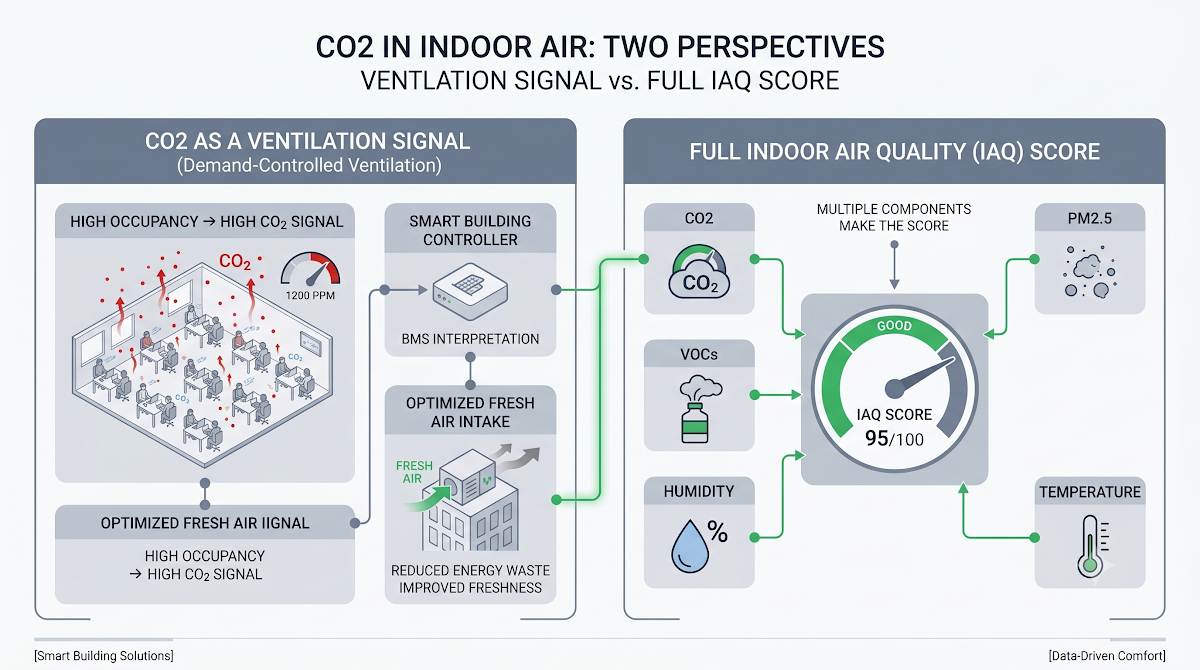
In simple terms, CO2 monitoring means continuously measuring carbon dioxide concentration in indoor spaces to understand whether ventilation is keeping up with how the space is being used. It is one of the most practical and widely used ways to understand occupancy-related ventilation performance in buildings. But it is important to frame it correctly: CO2 is not a complete picture of indoor air quality on its own. It is one very useful signal inside the broader IAQ monitoring strategy.
It is not a full IAQ score
This is the first thing worth clearing up.
A lot of people talk about CO2 as if it tells you everything about indoor air quality. It does not.
A room can have acceptable CO2 and still have problems with particulate matter, VOCs, humidity, temperature, odors, or poor filtration. CO2 is mainly useful because people exhale it, so it helps show whether ventilation is keeping up with occupancy and bioeffluent load. That makes it extremely useful, but still limited. In practice, CO2 is best treated as one core signal inside a wider air-quality picture that also includes temperature, humidity, particulate matter, and sometimes VOC tracking.
So if someone asks, “Is CO2 monitoring enough for indoor air quality?” the practical answer is no.
But if they ask, “Is CO2 one of the most useful continuous signals for ventilation performance?” the answer is absolutely yes.
Why CO2 matters in real buildings
The reason CO2 is so useful is simple: it rises when people occupy a space and ventilation does not increase enough to dilute it.
That makes it especially valuable in:
- meeting rooms
- classrooms
- open offices
- restaurants and cafes
- hotel breakfast and event spaces
- clinics and waiting areas
- shared workspaces
- public-facing areas with variable occupancy
In these spaces, CO2 gives building teams a much more useful signal than static assumptions. Instead of guessing how much air a room needs, the building can respond to what is actually happening.
This is also why CO2 is often closely connected to occupancy-based HVAC control. It is not a perfect occupancy sensor, but it is a strong demand signal in densely occupied spaces.
What CO2 monitoring is actually used for
In modern building operations, CO2 monitoring usually supports four main goals.
1. Ventilation verification
It helps teams see whether a space is likely getting enough outdoor air for the current occupancy level.
2. Demand-controlled ventilation
This is one of the most important use cases. Instead of ventilating the same way all day, the system can increase or reduce outdoor air in response to measured CO2. That is where CO2-driven ventilation becomes operationally powerful.
3. Occupancy-related HVAC response
CO2 can help indicate when dense occupancy is driving cooling load, ventilation demand, or comfort complaints.
4. IAQ reporting and certification
CO2 is widely used in healthy-building frameworks and continuous air monitoring strategies, which is one reason it matters for wellness and performance-oriented buildings.
How CO2 monitoring works in practice
The practical setup is usually straightforward.
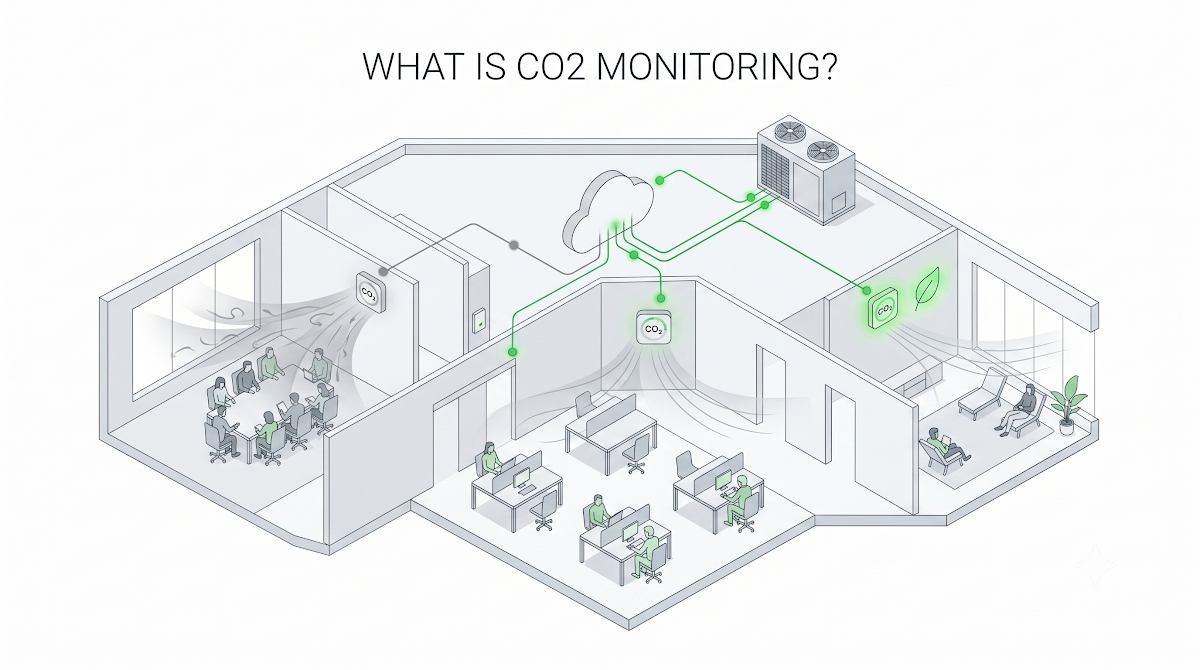
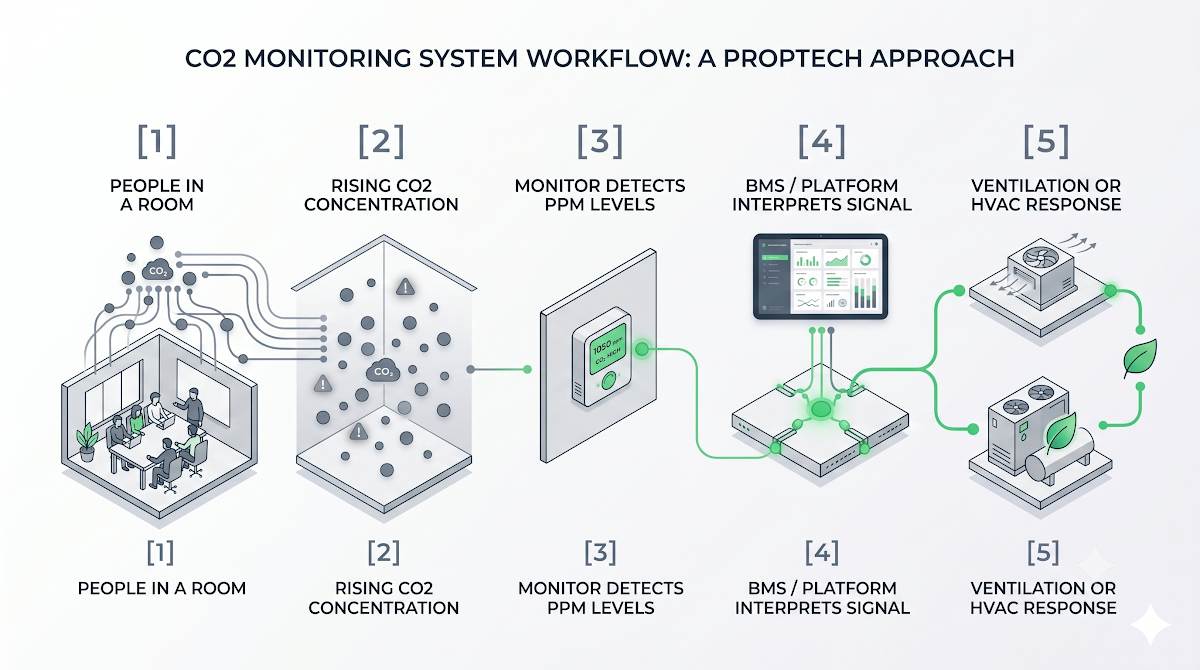
A CO2 monitor is placed in the space or thermal zone. The device measures indoor concentration in ppm and sends readings to a local display, BMS, cloud platform, or analytics layer. The building team can then use that signal in different ways:
- as a visibility metric
- as an alerting threshold
- as an HVAC control input
- as a reporting KPI
- as part of certification and compliance workflows
In simpler deployments, the CO2 value is only monitored and reviewed manually. In stronger setups, it becomes an active control signal that influences ventilation rates, setpoints, or occupancy-related logic.
That is where real-time CO2 tracking becomes useful in practice. The value is not just the number on the screen. It is the ability to turn the number into a decision, which is exactly what Sensgreen’s Indoor Air Quality Monitor is built for.
The threshold problem: what numbers actually matter?
This is where many CO2 articles become too simplistic.
People often throw around one number as if it is a universal answer. In reality, CO2 thresholds depend on the context and on what you are trying to manage.
For modern building operations, a few principles are more useful than memorizing one magic number:
- outdoor CO2 matters, because indoor readings are interpreted against the background level
- 1,000 ppm is often used as a practical operational reference, but it is not a universal health standard
- 800 ppm shows up often in higher-performance ventilation frameworks and healthier-space targets
- 5,000 ppm is an occupational exposure limit, not a comfort or ventilation target
That last point is especially important. People sometimes confuse workplace exposure limits with good building targets. They are not the same thing.
A better operational view is:
- use CO2 to understand whether a space is being ventilated well enough for its current use
- compare readings over time, not only at one moment
- connect the signal to occupancy pattern, HVAC response, and outdoor conditions
- do not treat CO2 alone as proof that air quality is good
What good practice looks like now
The better CO2 monitoring projects usually share a few traits.
They monitor continuously, not just occasionally
Spot checks are useful, but trend data is much more valuable. You want to know when the room rises, how long it stays elevated, and how fast it recovers.
They place sensors where readings are meaningful
CO2 data is only useful if the monitor is placed well. If it sits too close to a window, supply grille, or directly next to occupants, the signal can become misleading.
They connect CO2 to action
The strongest projects do not stop at dashboards. They use CO2 as a control or decision signal:
- ventilation reset
- alarm logic
- room tuning
- occupancy-based operation
- reporting and improvement loops
They combine CO2 with other data
This is especially important in real buildings. A space that feels bad may have high CO2, but it may also have humidity, temperature, or particulate issues. That is why good projects keep CO2 inside the broader air-quality picture.
They understand the space type
A meeting room, classroom, hotel restaurant, and open office do not behave the same way. The target, response logic, and recovery expectations should reflect how the space is actually used.
Where teams usually get it wrong
The most common mistakes are surprisingly consistent.
Treating CO2 as a complete IAQ metric
It is not. It is an important ventilation-related signal, but it does not replace PM, VOC, temperature, or humidity monitoring.
Using one generic threshold for every space
Different spaces have different occupancy patterns, ventilation strategies, and operational needs.
Looking at the number without looking at the pattern
A brief spike is not the same as chronic under-ventilation. Trend shape matters.
Installing sensors but never connecting them to building logic
This happens often. The device works, the dashboard exists, but the ventilation strategy never changes.
Ignoring outdoor baseline
Indoor CO2 makes more sense when it is understood relative to outdoor air rather than as a totally isolated number.
Where CO2 monitoring creates the most value
Some spaces benefit more than others.
Meeting rooms are one of the clearest examples. Occupancy rises quickly, air can feel bad fast, and the signal is very actionable.
Classrooms are another strong use case, because ventilation demand can shift heavily with student load.
Hotels are also important. In guest rooms, CO2 can support demand-based ventilation or room-state understanding in some setups. In breakfast rooms, conference spaces, and banquet areas, it becomes even more valuable because density changes quickly and static ventilation often underperforms.
Open offices and coworking spaces benefit when CO2 is tracked by zone rather than by whole floor. That is how ventilation becomes more responsive without being wasteful.
Why CO2 monitoring is growing strategically
CO2 matters not only because it is measurable, but because it sits at the intersection of several important building priorities:
- ventilation effectiveness
- occupant comfort
- cognitive performance conversations
- HVAC energy efficiency
- IAQ reporting
- healthy building certifications
That is why the topic also connects naturally to healthier-building standards, as covered in WELL Certification in the Middle East.
In other words, CO2 monitoring is not just an engineering metric anymore. It has become a bridge between air quality, occupant experience, and smarter building control.
Final thought
CO2 monitoring is really about one thing: understanding whether a space is breathing well enough for the people inside it.
That does not make it a complete air-quality metric. But it does make it one of the most useful live signals in building operations.
When it is measured well, trended properly, and connected to ventilation logic, CO2 monitoring helps buildings move from guesswork to real demand-based response.
That is why it matters. Not because the number itself is magical, but because the decisions behind it can be.
