

⚡ Quick Summary
Smart HVAC controls are the connected strategies and technologies used to run heating, cooling, and ventilation more intelligently than static schedules or manual adjustments, combining better control logic, richer sensing, connected devices, supervisory analytics, and predictive decision making.
In practice, five things work together:
- Local equipment control at the unit level
- Room and zone level sensing of real conditions
- Supervisory control logic (for example ASHRAE Guideline 36 sequences)
- Diagnostics and analytics for automated fault detection
- Optimization actions that change how the building behaves
Why it matters: HVAC systems rarely fail dramatically, they drift. Schedules stop matching real use, zones over and under condition, and overrides get forgotten. DOE notes high performance control sequences can deliver about 30 percent average annual HVAC energy savings, with similar peak demand reductions.
Most HVAC systems do not fail dramatically.
They drift.
A schedule no longer matches how a building is actually used. A few zones stay too cold while others keep overheating. Ventilation remains fixed even when occupancy changes. Setpoints get adjusted, overridden, and forgotten. The building still “works,” but it does not really behave the way operators want it to.
That is where smart HVAC controls start to matter.
Not as a shiny add-on. Not as a smart thermostat story. But as a better operating layer for how heating, cooling, and ventilation respond to real building conditions.
Today, smart HVAC control means much more than turning AC units on and off remotely. It is a combination of better control logic, richer sensing, connected devices, supervisory analytics, and increasingly predictive decision-making. ASHRAE’s Guideline 36 is built around high-performance HVAC sequences that improve energy efficiency, control stability, and real-time fault diagnostics. The U.S. Department of Energy also notes that high-performance control sequences can deliver about 30% average annual HVAC energy savings in commercial buildings, with similar peak demand reductions.
So what are smart HVAC controls, really?
Smart HVAC controls are the connected strategies and technologies used to run heating, cooling, and ventilation systems more intelligently than static schedules or manual adjustments.
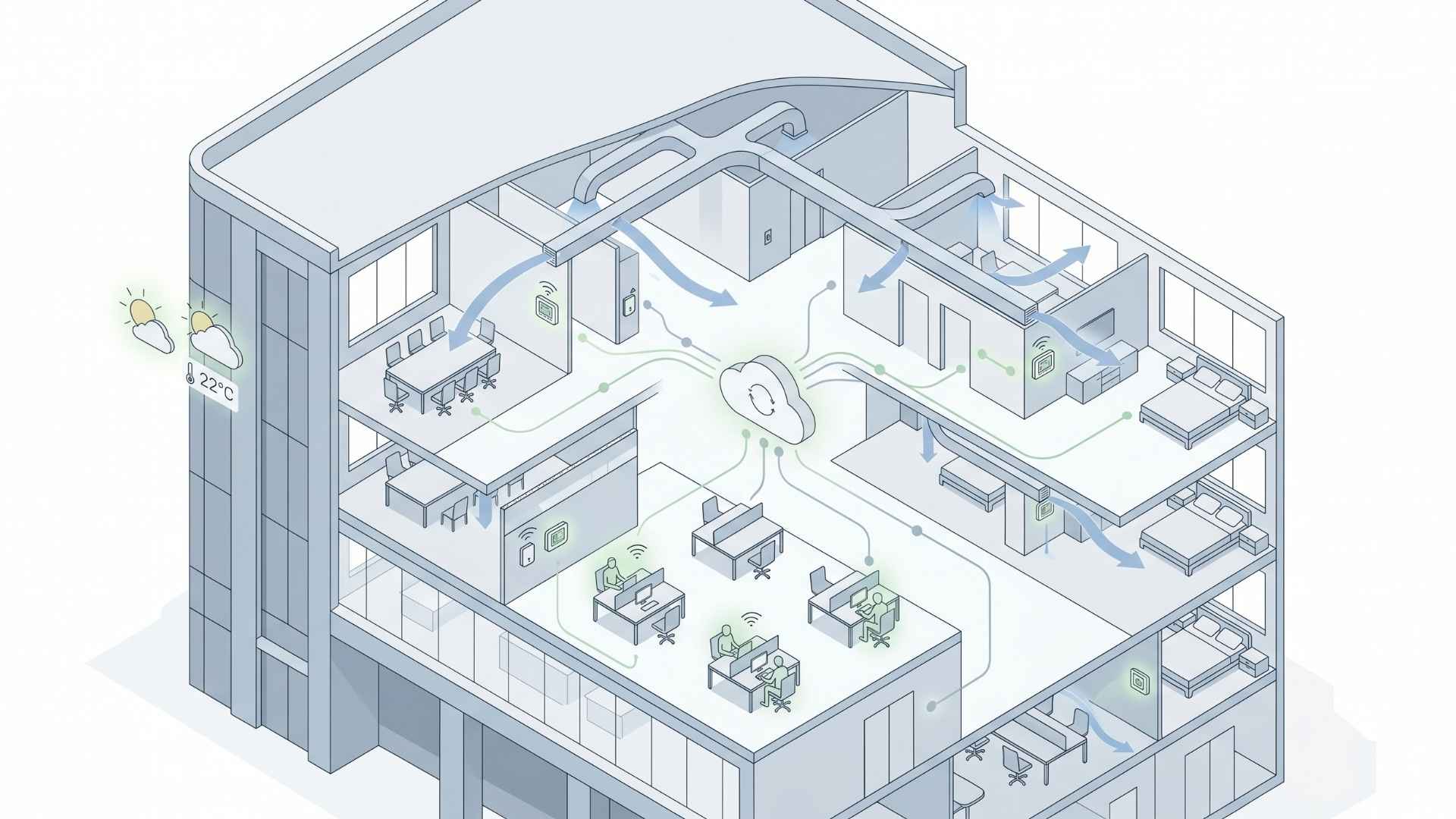
In practice, that usually means five things working together:
- local equipment control
- room or zone-level sensing
- supervisory control logic
- diagnostics and analytics
- optimization actions
That last part is important. Smart control is not only about seeing data. It is about using data to improve how the building behaves.
This is also where the industry has clearly moved in recent years. DOE’s current building-controls work is focused on wireless sensing, advanced control algorithms, open platforms, and grid-edge readiness. Its sensors-and-controls program highlights multifunction wireless sensor networks, adaptive controls, analytics, and occupant-centric strategies as core areas for modern building performance.
Why traditional HVAC controls often underperform
A lot of buildings already have controls. That is not the same thing as having good controls.
Traditional HVAC logic is often too static, too local, or too difficult to improve. A controller might do its job at equipment level, but no one has enough visibility to understand why the site keeps wasting energy or generating complaints.
We see the same patterns again and again in real buildings:
Schedules creep over time.
Manual overrides stay active longer than anyone intended.
Sensor bias slowly distorts decisions.
One problematic zone starts driving a system the wrong way.
Ventilation is delivered as if every hour were equally busy.
That is exactly why better sequences and better supervisory visibility matter. DOE’s building-controls research and fault-correction work keeps returning to the same operational themes: schedules, sensing quality, reset strategies, tuning, overrides, and non-physical control faults that quietly damage performance.
The shift that matters most: from isolated control to layered control
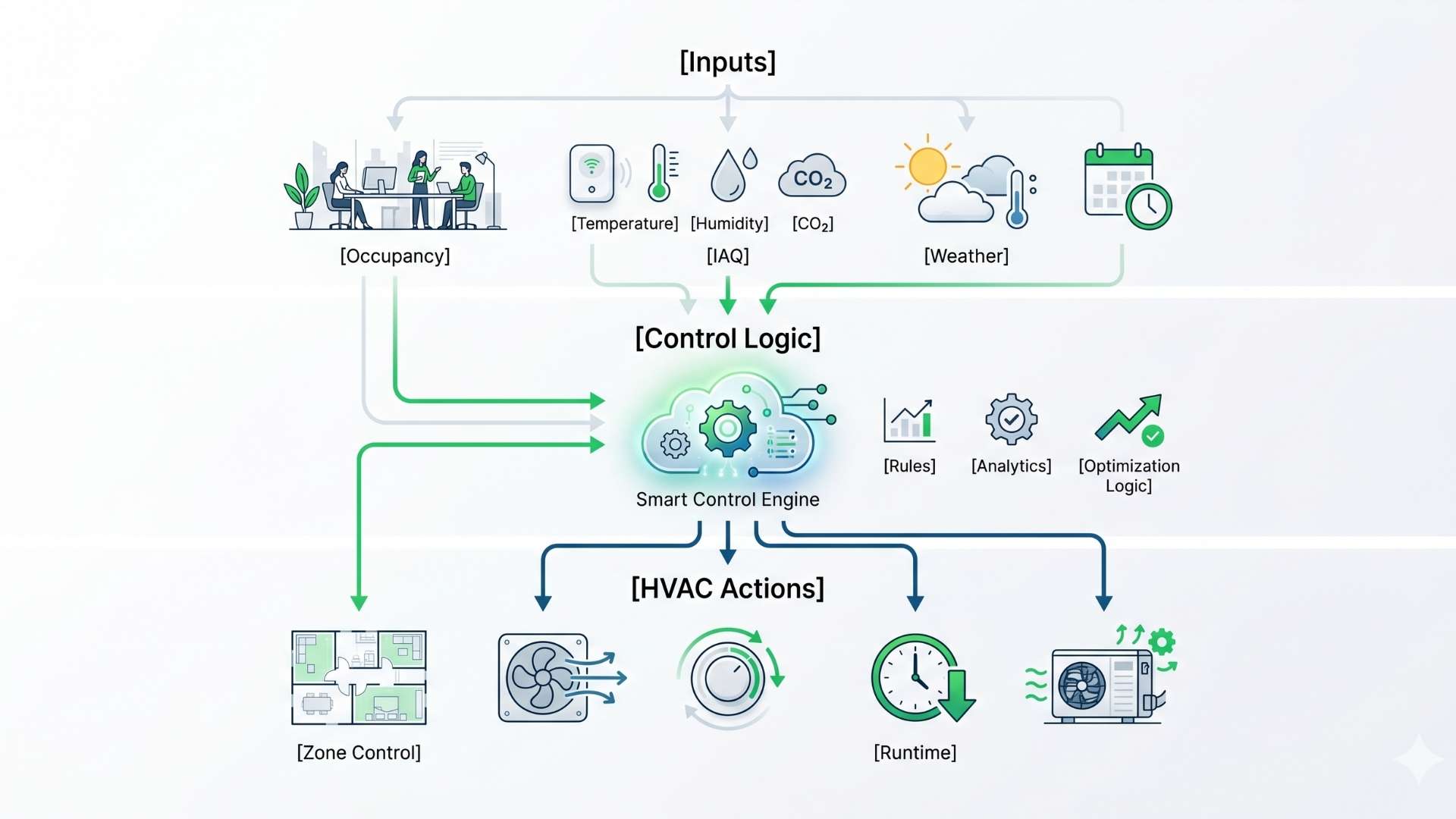
The best way to understand smart HVAC controls is to think in layers.
1. Equipment-level control
This is the basic logic inside or near the equipment. It applies to AHUs, FCUs, split ACs, VRF units, chillers, pumps, and radiator systems.
2. Zone and room intelligence
This is where real building context enters the picture. Temperature, humidity, CO2, occupancy, window status, and sometimes air quality signals start shaping how the system should behave.
3. Supervisory control
This is where buildings begin acting smarter at an operational level. Scheduling, setpoint resets, lockouts, demand-controlled ventilation, mode selection, and control scenarios sit here.
4. Diagnostics and analytics
This layer looks for drift, instability, abnormal runtimes, setpoint conflicts, ventilation problems, and patterns operators would otherwise miss.
5. Optimization
This is the layer most teams want to reach, but should not jump into too early. Here you get AI-assisted recommendations, predictive control logic, automated correction of some faults, and stronger coordination between comfort, energy, and operations.
This layered approach reflects where modern controls are heading. To understand how all of this fits into a broader HVAC optimization strategy, see our hub article on the topic. DOE’s work increasingly points toward adaptive, autonomous, and interoperable building control stacks rather than simple standalone automation. For more on the shift from automation to autonomous operations, see our 2026 smart buildings article.
 What the best smart HVAC strategies are doing differently now
 What the best smart HVAC strategies are doing differently now
A few years ago, many “smart HVAC” conversations were still centered on connected thermostats.
That is not enough anymore.
Here is what stronger projects are doing now.
They start with better sequences, not with AI hype
Before a building becomes intelligent, it needs to become logically consistent.
That is why high-performance sequences are such a big deal. ASHRAE Guideline 36 is important not because it sounds advanced, but because it gives the industry a more structured way to define HVAC behavior for efficiency, stability, and diagnostics. In other words, the system needs to know how it should behave before analytics or AI can add serious value.
They control ventilation based on reality
One of the clearest upgrades in modern HVAC control is moving away from fixed ventilation assumptions.
Ventilation should increasingly respond to what is actually happening in the building. DOE highlights dynamic ventilation control based on CO2 and occupancy, on a room-by-room or zone-by-zone basis, as an important direction for commercial buildings.
This matters because ventilation is where comfort, indoor air quality, and energy start colliding in a very real way. Too little ventilation creates risk. Too much ventilation wastes energy. Smart control helps teams stop guessing.
They use wireless sensing to modernize existing buildings faster
A lot of the real opportunity is not in brand-new buildings. It is in existing ones.
That is why wireless sensors and retrofit-friendly architectures matter so much. DOE explicitly includes multifunction wireless sensor networks as a key focus area for modern building controls. This is especially relevant for buildings where pulling new cabling is expensive, slow, or operationally disruptive.
This is also very aligned with how Sensgreen approaches modernization in practice. The company’s public positioning around Cloud BMS and smart AC/radiator control is built around retrofitting existing systems, adding wireless control and sensing, and layering AI-assisted diagnostics and automation on top of current building infrastructure rather than forcing a full rip-and-replace approach.
They move from alarms to diagnosis
One of the biggest maturity jumps in HVAC operations is moving beyond raw alarms.
An alarm tells you that something crossed a threshold. A diagnostic layer tells you what is likely happening, why it matters, and what should be checked next.
DOE’s fault-detection and autonomous-commissioning work is pushing in exactly this direction. The research focus is no longer only on spotting faults, but increasingly on automated fault correction and tighter two-way integration between diagnostics and building automation systems.
That matters because building teams do not need more noise. They need clearer action.
They prepare for predictive control
Rule-based control is still essential. But the direction of travel is clearly toward predictive control.
DOE states that even larger savings may be possible with advanced approaches such as predictive control, and NREL research shows strong potential for data-enabled predictive control for building HVAC systems without the full burden of traditional model creation and calibration.
In plain language, this means a building can start making better decisions before comfort drifts or energy waste becomes visible.
They connect HVAC to energy flexibility
HVAC is no longer only a comfort system. It is becoming a flexibility asset.
DOE’s Grid-Interactive Efficient Buildings work describes buildings that combine energy efficiency and demand flexibility with smart technologies and communications to improve affordability, comfort, and performance. HVAC is one of the biggest levers in that picture.
For operators, this means the future of smart HVAC is not just “keep rooms comfortable.” It is also “do that in a way that responds better to tariffs, peaks, and wider energy strategy.”
What this looks like in real buildings
In real projects, smart HVAC controls rarely arrive as one giant transformation. They usually start with a few clear pain points.
In hotels, the pain is often guest comfort versus energy waste. Rooms need to feel right quickly, but empty rooms should not be treated like occupied ones.
In offices, the issue is often mismatch. The building is scheduled for one pattern of use, while actual occupancy has changed completely.
In retail, teams usually want a faster and more scalable way to manage split ACs, FCUs, or zones across many locations without sending someone onsite every time settings drift.
In older mixed-use buildings, the problem is often fragmentation. Different systems exist, but they do not speak well to each other, and no one has a usable operating layer above them.
That is why the strongest smart HVAC projects do not begin with “Which AI model should we use?” They begin with “Where is the current control logic failing operationally?”
The practical implementation path
The smartest implementation path is usually the least theatrical one.
Step 1: Identify the operational pain
Look for comfort complaints, overtime operation, ventilation uncertainty, unstable zones, and unexplained energy waste.
Step 2: Map the controllable assets
Understand what already exists. BMS points, thermostats, VRF indoor units, split AC controllers, meters, room sensors, gateways, and protocols.
Step 3: Fix the basics first
Before adding an advanced optimization layer, clean up schedules, setpoints, control modes, overrides, and sensor quality.
Step 4: Add supervisory visibility
This is where trends become decisions. Runtime analysis, schedule verification, diagnostics, and rule-based alerts start creating operational clarity.
Step 5: Introduce advanced optimization
Only after the system becomes observable and logically stable does it make sense to push harder into AI-assisted tuning, predictive control, automated correction, or energy flexibility strategies.
That sequencing matters. Even ENERGY STAR guidance still points back to core operational discipline like schedules, optimal start/stop, and setpoint management, while DOE’s advanced controls work builds on top of better control foundations rather than replacing them.
Where Sensgreen’s perspective fits
At Sensgreen, the most useful lesson from the field is simple:
Most buildings do not need more dashboards first.
They need better operational logic.
That is why smart HVAC control should be treated as an operating system for better decisions, not just as a monitoring feature.
The right combination usually looks something like this:
existing BMS data where available, wireless room-level sensing where visibility is missing, automation scenarios tied to occupancy or environmental context, and an analytics layer that turns patterns into action.
That direction is also visible in Sensgreen’s current public product positioning. Its Cloud BMS messaging centers on spotting issues like schedule creep, conflicting setpoints, sensor drift, and stuck valves earlier, while its smart AC and radiator control offering focuses on remote control, occupancy- and window-based scenarios, and scalable wireless management.
Final thought
Smart HVAC controls are not about making buildings look futuristic.
They are about making them behave better.
Better logic. Better sensing. Better timing. Better visibility. Better decisions.
That is the real promise.
And for most commercial buildings, the opportunity is not starting from zero. It is finally improving systems that have been “good enough” for too long.
