


⚡ Quick Summary
VRF control is the logic, hardware, and software used to manage how a Variable Refrigerant Flow (VRF) system responds to real building conditions across multiple zones. VRF hardware provides flexible zone level heating and cooling, but the operational value comes from how it is controlled, not the equipment alone.
VRF control governs:
- Indoor unit response: how each unit reacts to its zone’s demand
- Outdoor unit modulation: how compressor capacity scales up and down
- Setpoints, schedules, and modes: managed per zone
- Multi zone coordination: balancing simultaneous heating and cooling needs
- Connection to central control: BAS integration and cloud analytics
Why it matters: Most buildings do not need the same conditioning everywhere at once. A meeting room overheats while a perimeter office runs cold. Good VRF control is the full decision layer that delivers the right heating or cooling to each zone, cutting waste and improving comfort.
Most buildings do not need the same heating or cooling everywhere, all at once.
That sounds obvious, but a surprising amount of HVAC waste still comes from systems that treat very different spaces as if they had the same needs. A meeting room fills up and overheats. A hotel room stays conditioned while empty. This is a challenge addressed in our article on smart AC controls for hotels. A perimeter office needs something different from an interior zone. A retail unit wants fast comfort in one area and almost no cooling in another.
This is exactly where VRF control starts to make sense.
VRF, or Variable Refrigerant Flow, is already known for giving buildings flexible, zone-level heating and cooling. But the real operational value does not come from the equipment alone. It comes from how the system is controlled. DOE defines VRF multi-split systems as systems with one or more outdoor units, at least one variable-speed compressor or staged compressor combination, and multiple indoor units that are individually metered and individually controlled through a common communications network. In simple terms, that means the system is designed from the start for modulation, zoning, and coordinated control.
So what is VRF control?
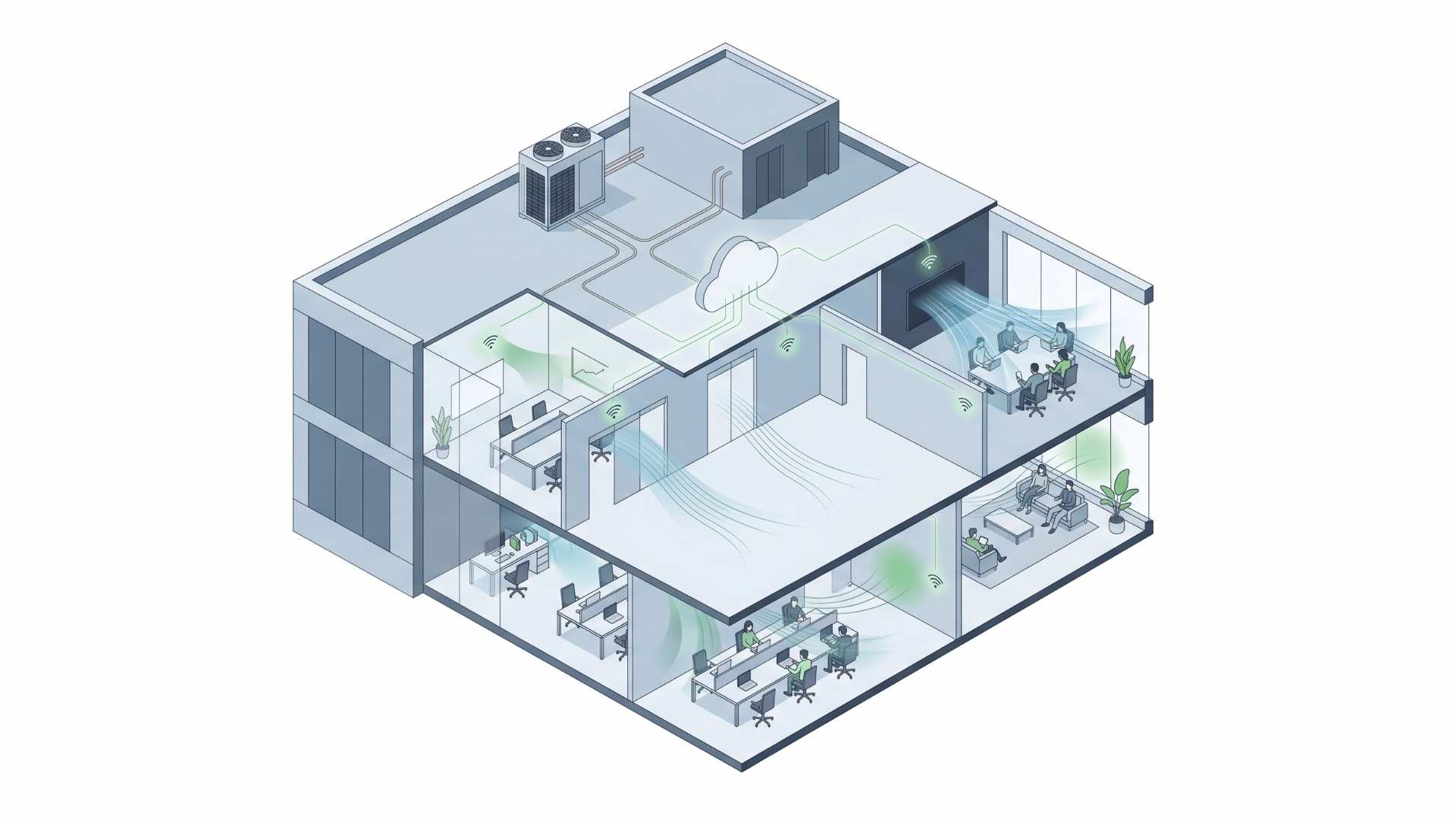
VRF control is the logic, hardware, and software used to manage how a VRF system responds to real building conditions.
That includes things like:
- how each indoor unit responds to zone demand
- how the outdoor unit modulates capacity
- how setpoints, schedules, and modes are managed
- how multiple zones are coordinated
- how the system connects to central control, building automation, and sometimes cloud-based analytics. For a broader picture, see our guide on HVAC optimization
In other words, VRF control is not just the wall controller in a room. It is the full decision layer behind how refrigerant-based heating and cooling are delivered across a building. Official VRF definitions from DOE and manufacturer references consistently point to the same core idea: multiple indoor units, variable capacity, and independent zone response under a shared system architecture.
Why VRF control matters more than people think
A lot of people understand VRF as an equipment choice. Fewer think about it as a control strategy.
But in practice, that is where a lot of the performance difference shows up.
Two buildings can both have VRF systems and perform very differently. One feels stable, efficient, and easy to manage. The other creates comfort complaints, weird mode conflicts, and limited visibility for operators. The difference is usually not that one building “has VRF” and the other does not. The difference is how well the controls, zoning logic, ventilation strategy, and supervisory layer were set up. ASHRAE created Guideline 41 specifically to provide guidance on the design, installation, and commissioning of VRF systems beyond the basic handbook treatment, which tells you a lot about how important correct implementation and control really are.
How VRF control actually works
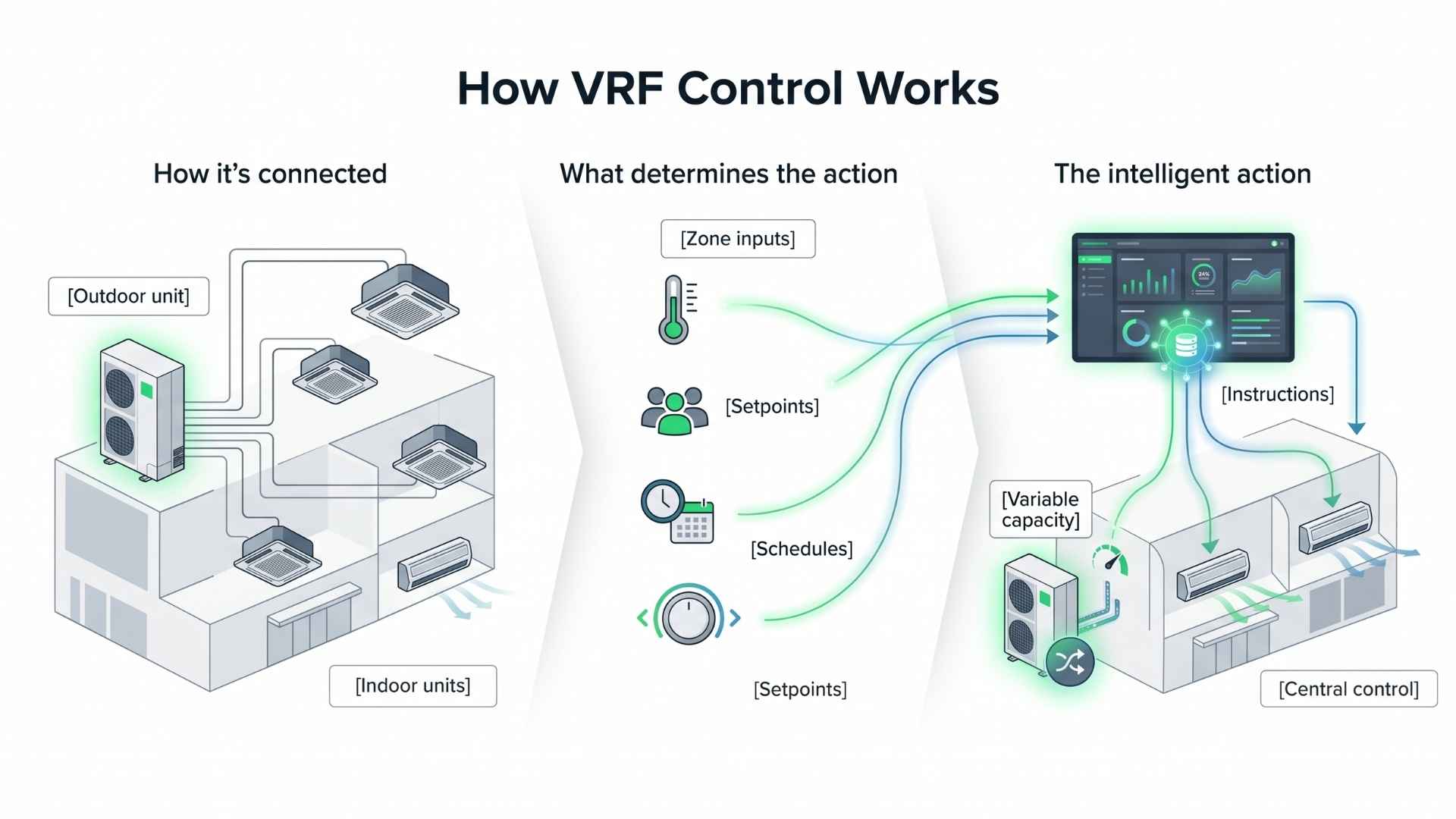
At a basic level, a VRF system modulates refrigerant flow according to what different zones need.
Instead of simply running at one fixed output and cycling hard on and off, the system continuously adjusts capacity. Each indoor unit serves its own zone, and the overall system coordinates these zones through a shared control architecture. That is why VRF has become attractive in buildings that want more localized comfort control without building a full chilled water system. Trane’s commercial explanation describes VRF as circulating refrigerant between a single outdoor unit and multiple indoor units, with capacity adjusted according to zone demand rather than simple full-load operation.
But the more interesting part is this: good VRF control is not only about load matching.
It is also about deciding:
- when a zone should be active
- what setpoint strategy should apply
- how occupancy affects operation
- how to avoid simultaneous waste
- how to coordinate central rules with local comfort
- how to integrate ventilation and humidity control
- how to monitor faults, overrides, and drift
That is why modern VRF control is increasingly paired with central controllers, BAS integration, cloud analytics, and room-level data rather than treated as a standalone island. Trane’s VRF controls and BAS materials explicitly frame VRF’s value around remote access, building automation, performance monitoring, and system-wide coordination rather than isolated thermostat control alone.
The biggest misconception: VRF control is not the same as ventilation control
This is where many projects get blurry.
VRF is excellent at space conditioning, but ventilation and dehumidification still need to be handled properly. In many better-performing designs, VRF is paired with a Dedicated Outdoor Air System, or DOAS. ASHRAE guidance on VRF makes this point very clearly: when DOAS is used with VRF, the sequence of operation has to be carefully modeled and coordinated for cooling, dehumidification, ventilation, and heating. Another ASHRAE addendum also notes the decoupled method where DOAS delivers conditioned ventilation air directly to the space, while the VRF system maintains space comfort.
That matters because one of the latest best practices in HVAC is to stop asking one system to do everything badly.
A strong VRF strategy often looks like this:
VRF handles zone comfort efficiently and flexibly, while a dedicated ventilation strategy handles outdoor air, humidity, and air quality more deliberately. That combination is also reflected in current decarbonization and performance-rating materials that reference VRF alongside DOAS, ERV, and DCV as part of higher-performance system strategies.
What modern VRF control looks like today
The market has moved well beyond simple handheld remotes and basic central scheduling.
The more mature VRF control setups now tend to include a few common characteristics.
1. Zone-level autonomy with central oversight
This is one of the biggest strengths of VRF. Individual rooms or zones can respond independently, but building teams still need a way to enforce broader operational logic such as schedules, temperature limits, mode strategies, and exceptions. Daikin’s VRV overview describes the core promise clearly: individual zone control across rooms and floors in commercial buildings.
2. Integration with building automation
VRF gets more useful when it is not isolated. BAS integration helps operators bring VRF into a larger operational picture that includes scheduling, visibility, fault response, occupancy, and other systems. Trane’s BAS guidance is blunt on this point: VRF reaches greater potential when paired with building automation.
3. Better use of occupancy and operating context
A modern control strategy should not treat an empty room and a full room the same way. Trane’s VRF BAS material specifically discusses modulation of refrigerant to zones according to occupancy-based HVAC control demand. That idea is increasingly important in hotels, offices, education spaces, and multi-zone commercial buildings where use patterns change constantly.
4. Stronger commissioning and sequence design
VRF can feel simple from the room side, but system behavior gets complex quickly as zone count, ventilation, and control scenarios grow. ASHRAE’s training and guidance around VRF repeatedly emphasize design, refrigerant safety, ventilation, humidity control, and commissioning, which is a sign that good results depend heavily on how the control logic is planned and validated.
5. Predictive and AI-assisted tuning is starting to appear
This is one of the more interesting newer developments. Daikin has publicly described remote automatic energy-saving control that predicts cooling load based on operational data and tunes control settings in advance. That does not mean every VRF system today is running advanced predictive optimization, but it does show where the industry is heading: smarter tuning before conditions drift, not only after.
Where VRF control makes the most sense
VRF control is especially attractive when a building needs flexible zoning and partial-load efficiency.
That often includes:
- hotels
- offices with mixed occupancy patterns
- schools and universities
- retail units
- healthcare admin spaces
- retrofit projects where flexibility and electrification matter
DOE’s commercial VRF references and cold-climate validation work point to growing confidence in VRF performance across commercial, institutional, and multifamily settings, especially as the market pushes further toward electrified HVAC solutions.
In the field, the appeal is usually very practical. Operators want room-level comfort without sending someone onsite every time settings drift. Owners want better electrification pathways. Engineers want a system that can serve multiple zones with more control granularity than conventional split systems. And increasingly, teams want all of that without losing central visibility.
Where projects usually go wrong
The most common VRF control problems are not mysterious.
They usually come from one of five places:
- treating VRF like a standalone room system instead of part of building operations
- weak coordination between VRF and ventilation
- poor schedule and setpoint governance
- limited visibility into overrides, faults, and mode conflicts
- underestimating commissioning and sequence design
This is why “smart control” matters so much in VRF projects. The hardware can be very capable, but if the supervisory layer is weak, the system ends up behaving like a collection of disconnected indoor units instead of a well-managed building system.
A practical way to think about VRF control
The best way to explain VRF control is this:
VRF gives you flexible capacity. Control determines whether that flexibility turns into performance.
That performance can mean different things depending on the building:
- better guest comfort in hospitality
- fewer complaints in offices
- less wasted runtime in underused zones
- better alignment with electrification goals
- easier remote management across many spaces
- more stable operations when occupancy patterns shift
At Sensgreen, this is the broader lens we find most useful. The conversation should not stop at “Does the building have VRF?” The better question is: How intelligently is that VRF system being operated?
Because that is where real value starts to show up.
Final thought
VRF control is not just about controlling indoor units.
It is about managing zoning, modulation, coordination, ventilation strategy, visibility, and operational logic in a way that fits how buildings actually behave. Hardware like smart AC and radiator control units are part of making that possible.
That is why the strongest VRF projects are no longer only equipment projects.
They are smart HVAC controls projects as much as equipment projects.
And increasingly, they are data projects too.
