

⚡ Quick Summary
A Building Automation System (BAS) is a centralized, mostly hardwired system that runs a building’s core mechanical and electrical equipment (HVAC, lighting, fire, access, elevators). IoT sensors are wireless, networked devices that collect real time environmental and usage data and send it to the cloud for analytics. BAS controls equipment; IoT measures and surfaces conditions, and the best setups combine both.
• Wiring: BAS uses hardwired proprietary protocols (BACnet, Modbus, LonWorks); IoT is wireless and easy to add
• Cost: BAS runs roughly 2.50 to 7.50 USD per sq ft plus 1,000 to 2,000 USD per month licensing; IoT is far lower and faster to deploy
• Strengths: BAS gives reliability and deep equipment control; IoT gives speed, coverage of gaps, and rich analytics
• Weakness: BAS is slow, costly, and prone to vendor lock in; IoT mostly monitors rather than commands equipment
Why it matters: They are not really competitors. BAS handles core control while IoT cheaply fills the visibility gaps, and many 2026 retrofits layer IoT on top of an existing BAS instead of replacing it.
 Two technologies, one goal, two very different price tags.
If you manage a commercial building, you’ve probably heard both terms thrown around: Building Automation System (BAS) and IoT sensors. Sometimes they’re used interchangeably. Sometimes they’re pitched as competing solutions. Neither framing is quite right.
The real difference between the two, and how they can complement each other, matters more than ever as building owners face pressure to cut energy costs, improve occupant comfort, and hit sustainability targets without tearing out existing infrastructure. The cost gap between these two approaches has also widened dramatically, which changes the calculation for almost every retrofit decision in 2026.
This article covers what each technology actually does, where each one excels, where each one falls short, what each one costs in real numbers, and how modern platforms are productively blurring the line between them.
What Is a Building Automation System (BAS)?
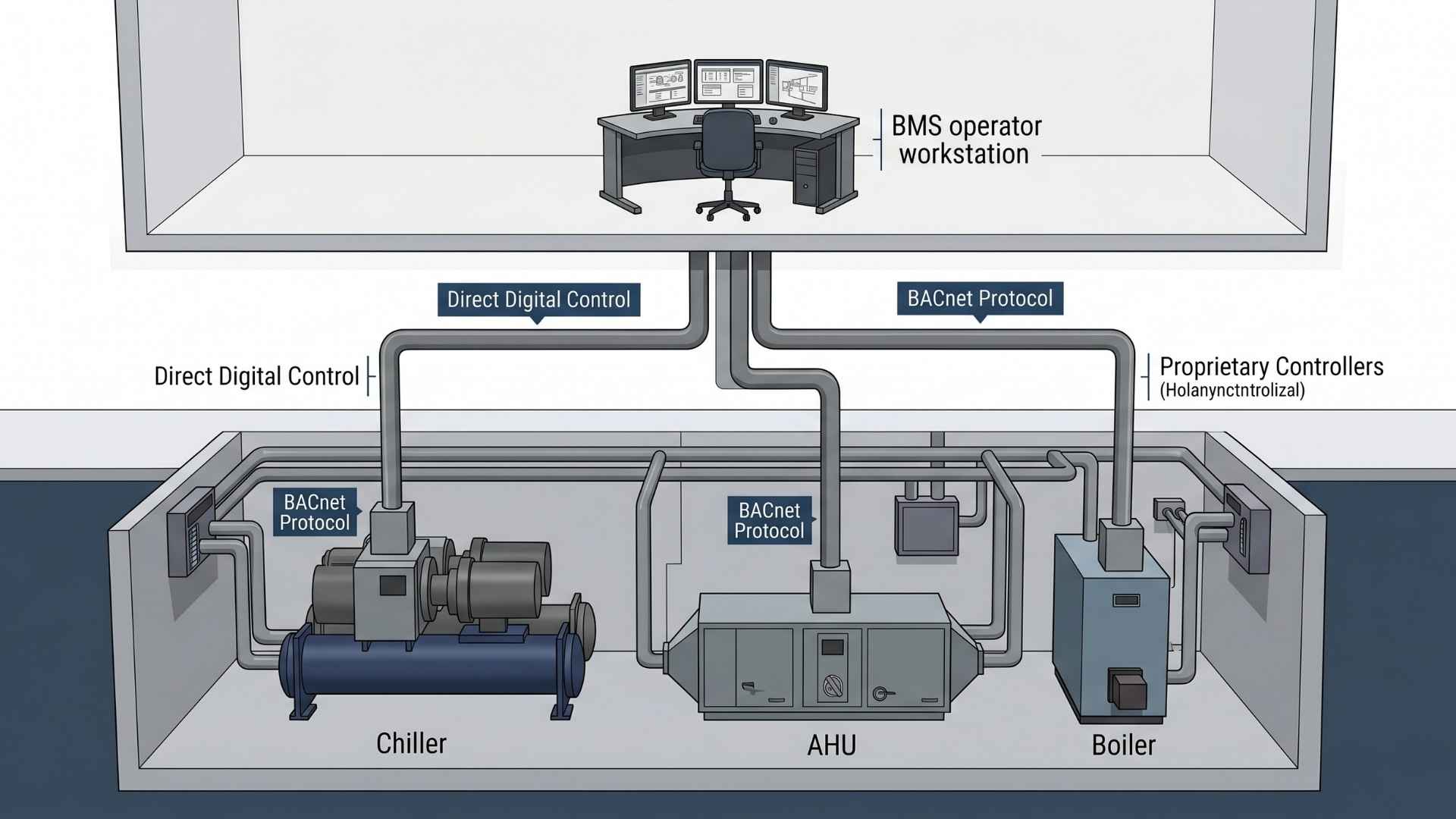
A Building Automation System, also called a Building Management System (BMS), is a centralized control infrastructure built to manage a building’s mechanical and electrical systems: HVAC, lighting, fire suppression, access control, and elevators.
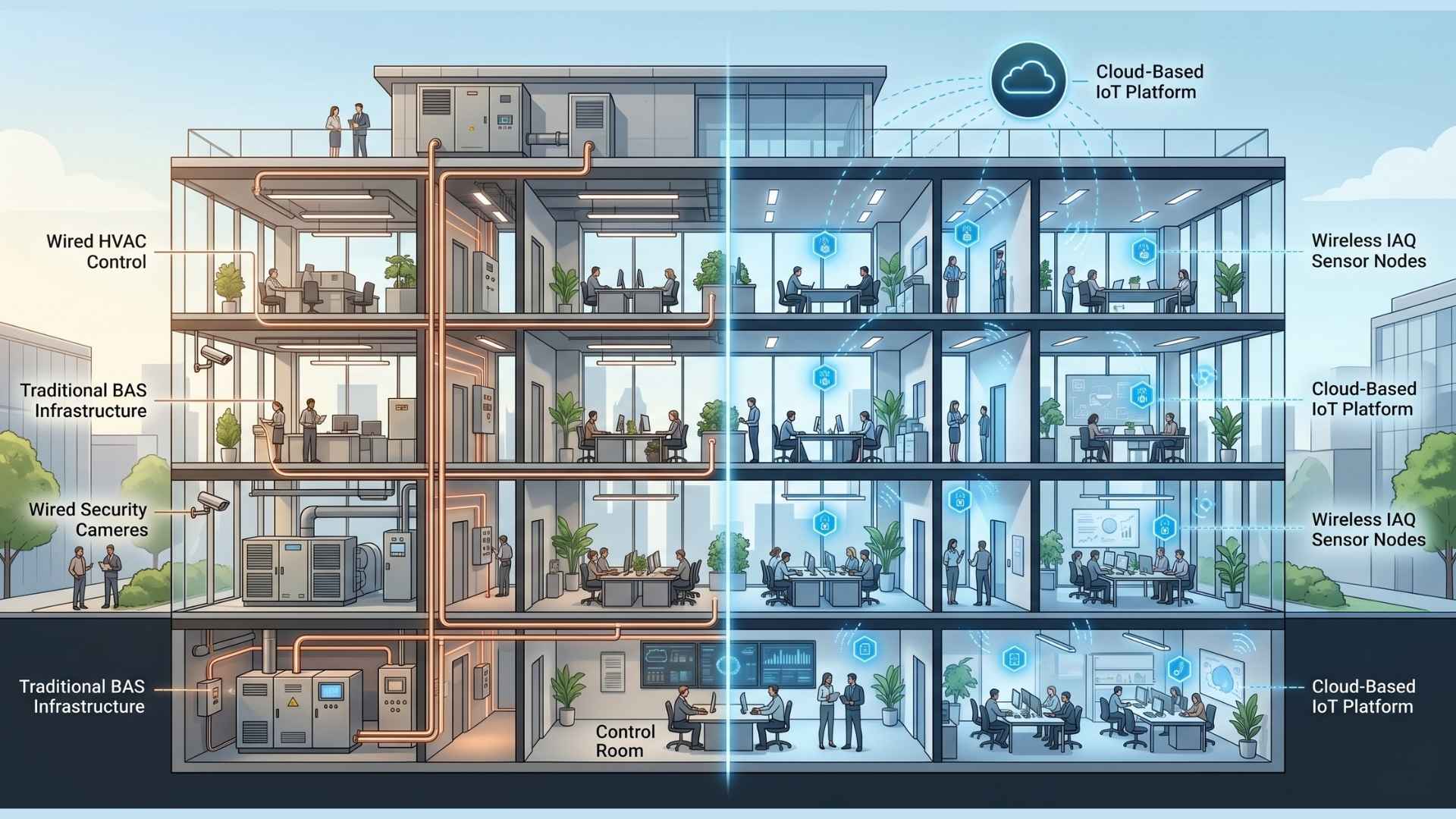
BAS platforms have been around since the 1970s. They typically rely on hardwired sensors and controllers communicating over proprietary protocols like BACnet, Modbus, or LonWorks. The core idea is integration. One system ties together all critical building systems and lets operators monitor and control them from a single interface.
What BAS Does Well
Coordinated control of complex systems. A BAS can automatically adjust HVAC based on occupancy schedules, outside temperature, and time of day, simultaneously, across an entire building.
Reliability at scale. Hardwired systems don’t drop connections. In mission-critical environments like hospitals or data centers, that reliability is non-negotiable.
Deep integration with mechanical systems. BAS controllers are often embedded directly into chillers, air handling units, and variable air volume boxes. They’re not just reading data. They’re commanding equipment.
A mature operational track record. Building engineers know how to work with BAS. The workflows, certifications, and vendor ecosystems are well established.
Where BAS Falls Short
The limitations of traditional BAS are getting harder to ignore.
Installation is expensive and slow. Industry benchmarks consistently place traditional BAS deployment between $2.50 and $7.50 per square foot, depending on building complexity. For a 50,000 square foot building, that’s roughly $125,000 to $350,000 in upfront cost. Push to a 100,000 square foot facility and you’re looking at $250,000 to $750,000 before counting ongoing service contracts. Retrofitting an older building is even more painful, with construction, conduit, and commissioning often consuming months.
Recurring costs add up. Most BAS vendors charge ongoing licensing and maintenance fees based on the number of devices or data points connected. Industry analyses estimate $1,000 to $2,000 per month in licensing and maintenance is typical, and a full three-year cost (initial plus recurring) for a mid-sized commercial deployment can land anywhere from $550,000 to over $1 million.
Proprietary lock-in is real. Many BAS vendors use closed protocols, meaning your data lives in their ecosystem. Switching vendors or integrating third-party tools often requires expensive middleware or custom development.
Coverage gaps are common. A BAS monitors what it was designed to monitor. Individual rooms, tenant spaces, or areas added after the original installation often fall completely outside its visibility. According to U.S. Department of Energy data, roughly 90 percent of commercial buildings still operate without any smart building functionality, and even among those that have a BAS, only the highest-traffic zones are typically covered.
Data is operational, not analytical. Traditional BAS platforms were built to control systems, not surface insights. Extracting meaningful analytics, such as energy trends, anomaly detection, and occupancy patterns, typically requires additional software layers on top.
What Are IoT Sensors in a Building Context?
IoT (Internet of Things) sensors are wireless or networked devices that collect real-time data from the physical environment and transmit it to a cloud platform or local server for processing and analysis.
In a commercial building, IoT sensors might monitor:
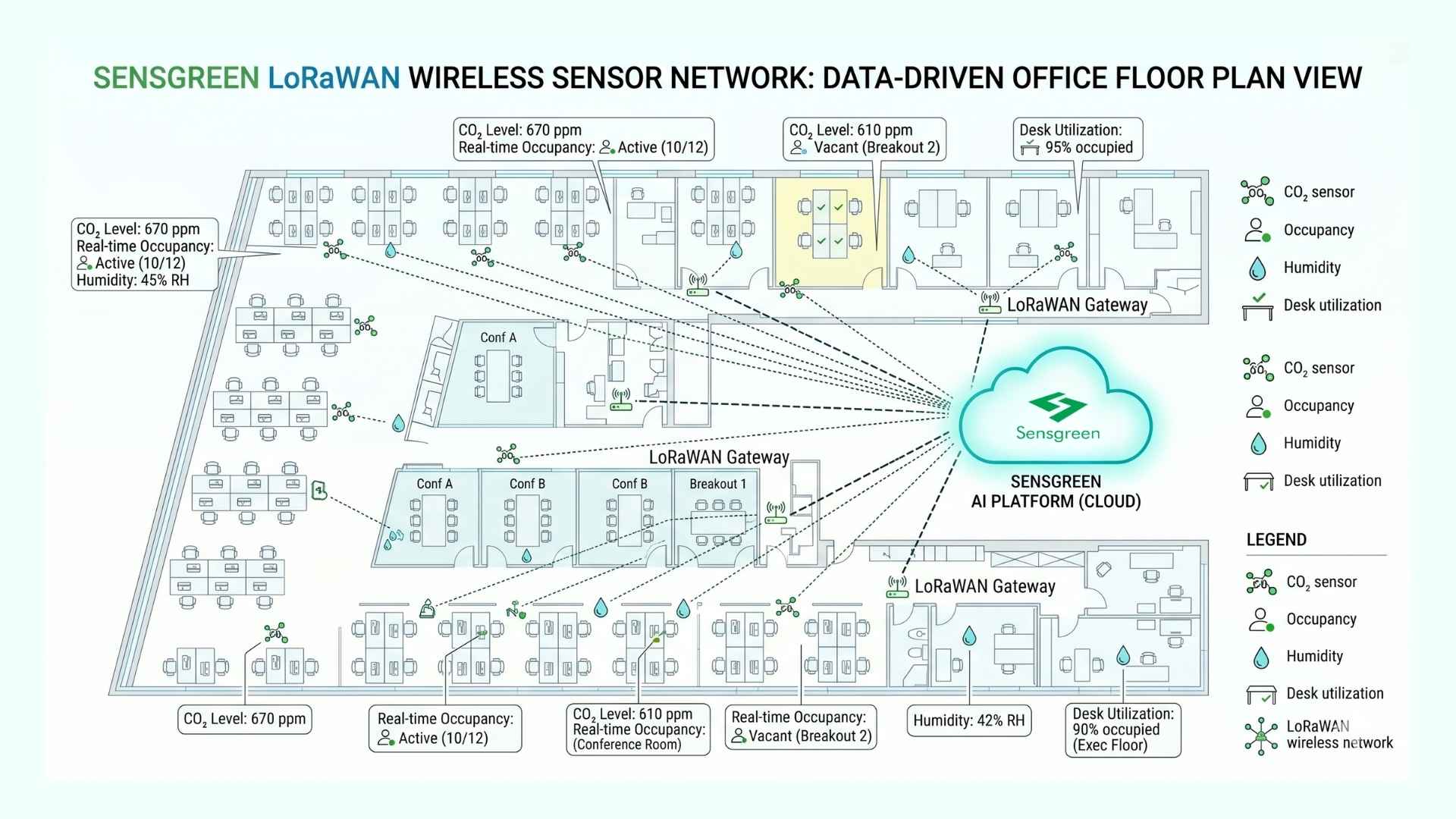
- Air quality (CO₂, VOCs, particulate matter, humidity, temperature)
- Occupancy and space utilization
- Energy consumption at the circuit or equipment level
- Water usage and leak detection
- Light levels and noise
Unlike BAS controllers, most IoT sensors are passive. They observe and report. They don’t directly command a chiller or open a damper. What they do is generate dense, granular data streams that feed into dashboards, analytics engines, or automation rules.
What IoT Sensors Do Well
Deployment is fast and flexible. Wireless IoT sensors can be installed in hours, not weeks. No conduit, no major construction. That makes them ideal for retrofits, tenant spaces, and areas the original BAS never reached. In one Sensgreen deployment, the integration partner connected 500 devices to an existing BMS in a single day, a task that would have taken significantly longer with wired installations.
Coverage is granular. You can put a sensor in every room on every floor, tracking conditions at a level of detail that hardwired BAS infrastructure rarely achieves cost-effectively.
Data is rich and analytics-ready. IoT platforms are built around data. Time-series storage, trend visualization, anomaly detection, and integration with third-party analytics tools are typically native capabilities, not add-ons.
They’re hardware-agnostic. Most modern IoT platforms support sensors from multiple manufacturers, giving buyers flexibility and reducing vendor lock-in risk.
Expansion is straightforward. Adding 50 more sensors to an IoT deployment is a procurement and configuration task, not a construction project.
Where IoT Sensors Fall Short
They don’t directly control building systems. An IoT sensor can tell you a conference room is too warm. Without integration work, it can’t command the VAV box to open.
Wireless reliability has limits. Battery-powered wireless sensors can struggle with connectivity in dense concrete buildings, and battery management adds operational overhead at scale.
Data without action has limited value. A platform that surfaces insights but can’t close the loop into control creates a manual gap. Someone still has to act on the information.
Security and data governance require attention. Cloud-connected IoT deployments introduce cybersecurity considerations that IT and facilities teams need to manage carefully.
The Cost Comparison That Changes the Conversation
This is where the conversation between BAS and IoT often shifts from “which is better” to “which can we actually afford.”
A full traditional BAS deployment for a 50,000 square foot commercial building lands somewhere between $125,000 and $350,000 in upfront cost, plus $12,000 to $24,000 per year in licensing and maintenance fees. The payback period typically stretches to four years or longer, which is why an estimated 90 percent of U.S. commercial buildings still don’t have any smart building functionality at all. The math has historically priced out everyone except large enterprises.
An IoT-native platform deployment for the same building looks completely different. Cloud-based IoT sensor platforms typically range from $5,000 to $50,000 for an initial deployment depending on sensor density, with some industry projections pointing toward eventual costs as low as $0.75 per square foot, roughly five times less than a traditional BMS. Sensgreen’s deployments often fall well within that range because they use wireless LoRaWAN-based sensors that don’t require conduit, custom integration work, or ground-up commissioning.
For context: a Sensgreen deployment that delivered an 8 percent energy reduction across an 80-building Dubai residential portfolio used 400 sensors total. That’s an average of 5 sensors per building, deployed wirelessly, generating measurable savings across the entire portfolio in a fraction of the time and cost a traditional BAS rollout would have required.
The cost gap between the two approaches is also the reason hybrid deployments are becoming the standard. Most buildings can’t justify replacing a working BAS, but they can absolutely justify adding an IoT layer on top.
BAS vs IoT Sensors: A Direct Comparison
| Dimension | Building Automation System | IoT Sensor Platform |
| Primary function | Control building systems | Monitor and analyze conditions |
| Installation | Hardwired, complex, expensive | Wireless, fast, low-cost |
| Upfront cost (50,000 sqft) | $125,000 to $350,000 | $5,000 to $50,000 |
| Recurring cost | $1,000 to $2,000 per month typical | Subscription-based, lower volume |
| Time to deploy | Months | Days to weeks |
| Data granularity | System-level | Room-level and beyond |
| Analytics capability | Limited (operational focus) | Strong (built for data) |
| Retrofit friendliness | Low | High |
| Vendor lock-in risk | High (proprietary protocols) | Varies (open platforms exist) |
| Direct equipment control | Yes | Typically no (without integration) |
| Scalability cost | High | Low |
| Best for | Mission-critical control | Insight, optimization, coverage gaps |
When to Use Each, and When to Use Both
Framing this as BAS versus IoT sensors is usually a false choice. In most real-world commercial buildings, the right answer is a thoughtful combination of both.
Use a BAS when:
- You need direct, reliable control of major mechanical systems
- You’re operating in a regulated environment such as healthcare, pharma, or data centers, where control reliability is non-negotiable
- You’re building a new facility and can design the control infrastructure from scratch
- Operational continuity is the priority, not analytics
Use IoT sensors when:
- You’re retrofitting an existing building and can’t justify the cost of full BAS expansion
- You need granular data from spaces the BAS doesn’t cover, such as individual offices, meeting rooms, or common areas
- Your priority is occupant experience, air quality monitoring, or space utilization analysis
- You want to build an analytics layer on top of existing infrastructure without replacing it
Use both together when:
- You have a BAS managing core systems but want richer data and deeper analytics
- You need to extend visibility into areas the BAS doesn’t reach
- You’re trying to optimize energy performance beyond what the BAS alone can deliver
- You want automated responses to occupant-level conditions, such as triggering HVAC adjustments based on real-time CO₂ readings from IoT sensors
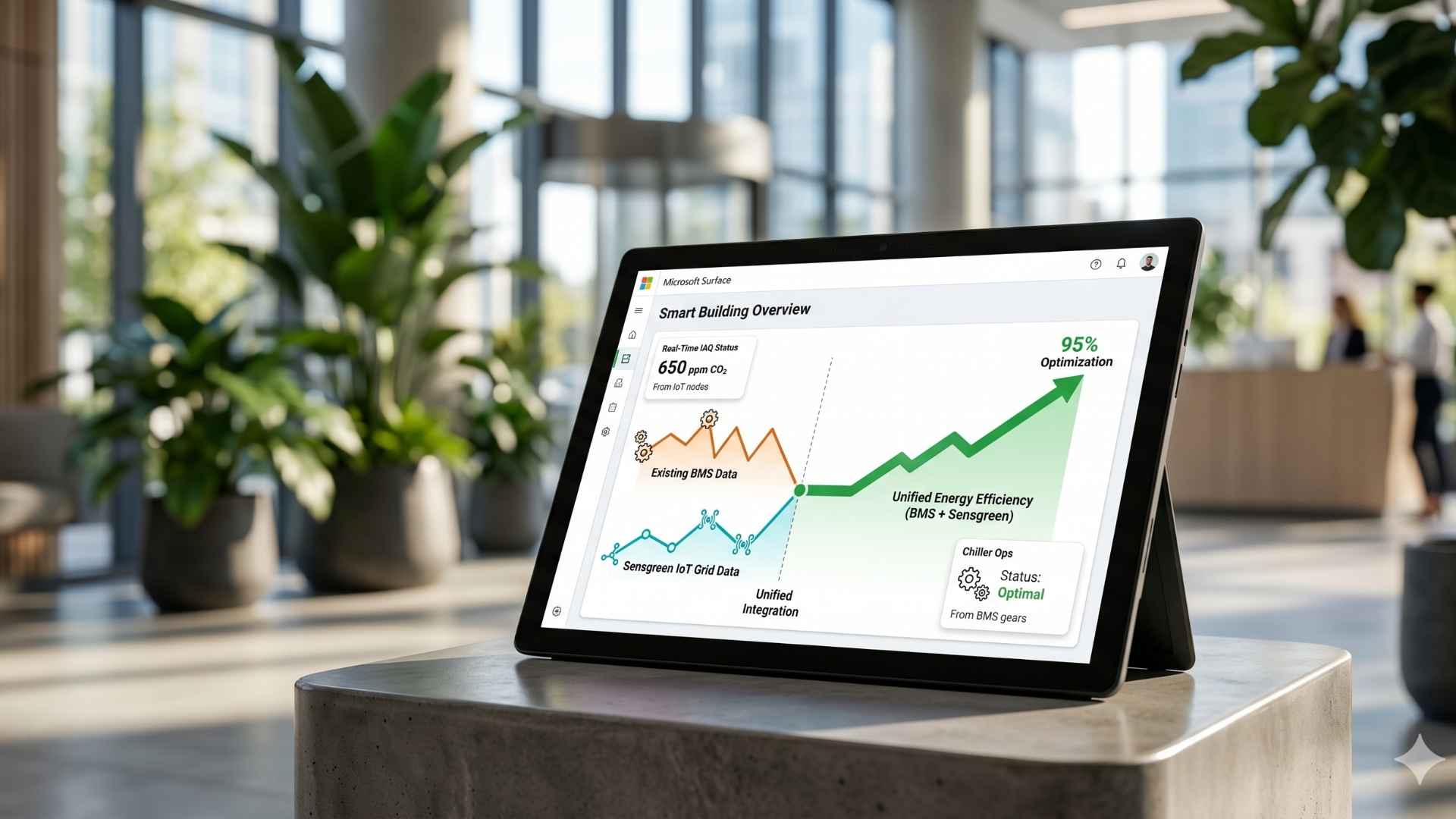
This hybrid approach is increasingly the standard in well-managed commercial buildings. The BAS handles the heavy lifting of equipment control. IoT sensors provide the environmental intelligence. A unified platform ties them together.
How Modern IoT Platforms Are Changing the Equation
The line between BAS and IoT is getting blurrier, and that’s largely intentional.
Newer IoT-native platforms aren’t just passive data collectors. They’re incorporating automation logic, integration layers, and control capabilities that allow them to interact with BAS infrastructure or, in some cases, replace it for specific use cases.
This matters because the traditional BAS model has a fundamental economics problem: full coverage is prohibitively expensive for most buildings. Most commercial properties have significant monitoring blind spots simply because it was never cost-effective to wire every room and every zone.
IoT-native platforms solve that coverage problem. And when they’re built on open integration standards, they can connect to existing BAS infrastructure rather than compete with it, giving building operators a unified view without a rip-and-replace project.
A clear example: Sensgreen’s deployment at one of the largest malls in Bahrain. The mall needed to digitize building operations without replacing its legacy BMS. Sensgreen’s modular, AI-powered platform was deployed via edge computing on top of the existing BMS, delivering real-time visibility, actionable insights, and protocol-agnostic integration without the cost or disruption of replacing the control infrastructure already in place.
The shift is also being driven by what building operators actually want. The demand isn’t just for control. It’s for insight. Why is energy consumption spiking on Tuesday afternoons? Which floors have the worst air quality? Which conference rooms are booked but consistently empty? These are questions traditional BAS platforms weren’t designed to answer. IoT-native platforms are.
What This Means for Building Owners and Operators
A few practical things worth keeping in mind when evaluating building technology.
Don’t assume your BAS is giving you the full picture. Most BAS deployments have coverage gaps, data silos, and limited analytics. Having a BAS doesn’t mean having visibility.
Don’t assume IoT sensors alone are enough. If you need to control equipment, not just monitor it, you need integration with your control infrastructure, whether that’s a BAS or a platform that can bridge both.
Ask about integration, not just features. The most valuable building technology investments connect to what you already have. The ones that require you to throw everything away rarely deliver on their promise.
Run the cost math honestly. The upfront price tag is one thing. Three-year total cost of ownership, including licensing, maintenance, and the cost of inaction (energy waste, comfort complaints, missed compliance windows), tells a more accurate story.
Think in layers. Control infrastructure (BAS) at the base. Monitoring and data collection (IoT sensors) in the middle. Analytics and automation logic at the top. Each layer serves a distinct purpose, and the most effective building operations run all three.
Where Sensgreen Fits
Sensgreen is built around exactly this kind of layered thinking. The platform combines IoT sensor integration with real-time analytics and AI-driven automation capabilities, designed to work alongside existing BAS infrastructure, sit on top of legacy BMS as a unifying intelligence layer, or function as a standalone solution for buildings that don’t have a BAS at all.
For buildings with mature BAS deployments, Sensgreen connects through standard protocols like BACnet, Modbus, and KNX to create a unified operational view without displacing the control systems already in place. The Bahrain mall deployment is a working example: legacy BMS preserved, full visibility added, operations digitized without a rip-and-replace project.
For retrofits and tenant spaces where deploying a traditional BAS would be cost-prohibitive, Sensgreen’s wireless LoRaWAN-based sensors fill the coverage gaps quickly. The Dubai office lighting deployment cut lighting energy consumption by 25 percent within the first month of deployment, on a budget no full BAS retrofit could match. For step-by-step device onboarding, see connecting IoT devices to the platform.
For portfolio operators managing multiple buildings, Sensgreen’s centralized platform handles the unified view across all of them, the way the 80-building Dubai residential portfolio is managed today.
The result is a platform that addresses the core limitation of traditional BAS, the gap between operational control and actionable insight, without forcing building operators into a ground-up rebuild.
Conclusion
Building Automation Systems and IoT sensors aren’t really competitors. They’re different tools that solve different parts of the same problem: making buildings easier to manage, more efficient to operate, and better for the people inside them.
BAS platforms provide the control infrastructure that large commercial buildings depend on. IoT sensors provide the granular, real-time environmental data, plus the analytics layer, that BAS platforms were never designed to deliver. And the cost gap between the two approaches is exactly why most building operators in 2026 are choosing to layer rather than replace.
The most effective building operations today use both, connected through a platform that can turn data into decisions.
If you’re evaluating your building technology stack and trying to identify where the gaps are, the question isn’t which technology to choose. It’s how to make them work together.
