

⚡ Quick Summary
BMS integration means connecting a building’s systems, devices, and data sources (HVAC, meters, lighting, access control, IAQ, occupancy, energy) into one usable operating environment so teams can monitor, control, analyze, and improve the building coherently. It is about making systems useful together, not just technically reachable.
Good BMS integration involves:
- Protocol connectivity: bridging BACnet, Modbus, and other protocols via a dedicated Sensgreen Integration Hub (necessary, but only the start)
- Unified data: exposing sensors and actuators through one consistent interface
- Cross system logic: letting occupancy, IAQ, and energy data trigger coordinated actions
- Supervisory visibility: one place for alarms, trends, and analytics across all systems
Why it matters: Many buildings are automated but operationally fragmented, each system in its own silo. Integration turns scattered systems into a single controllable building, which ASHRAE Guideline 13 treats as core controls discipline rather than an afterthought.
A lot of buildings already have systems.
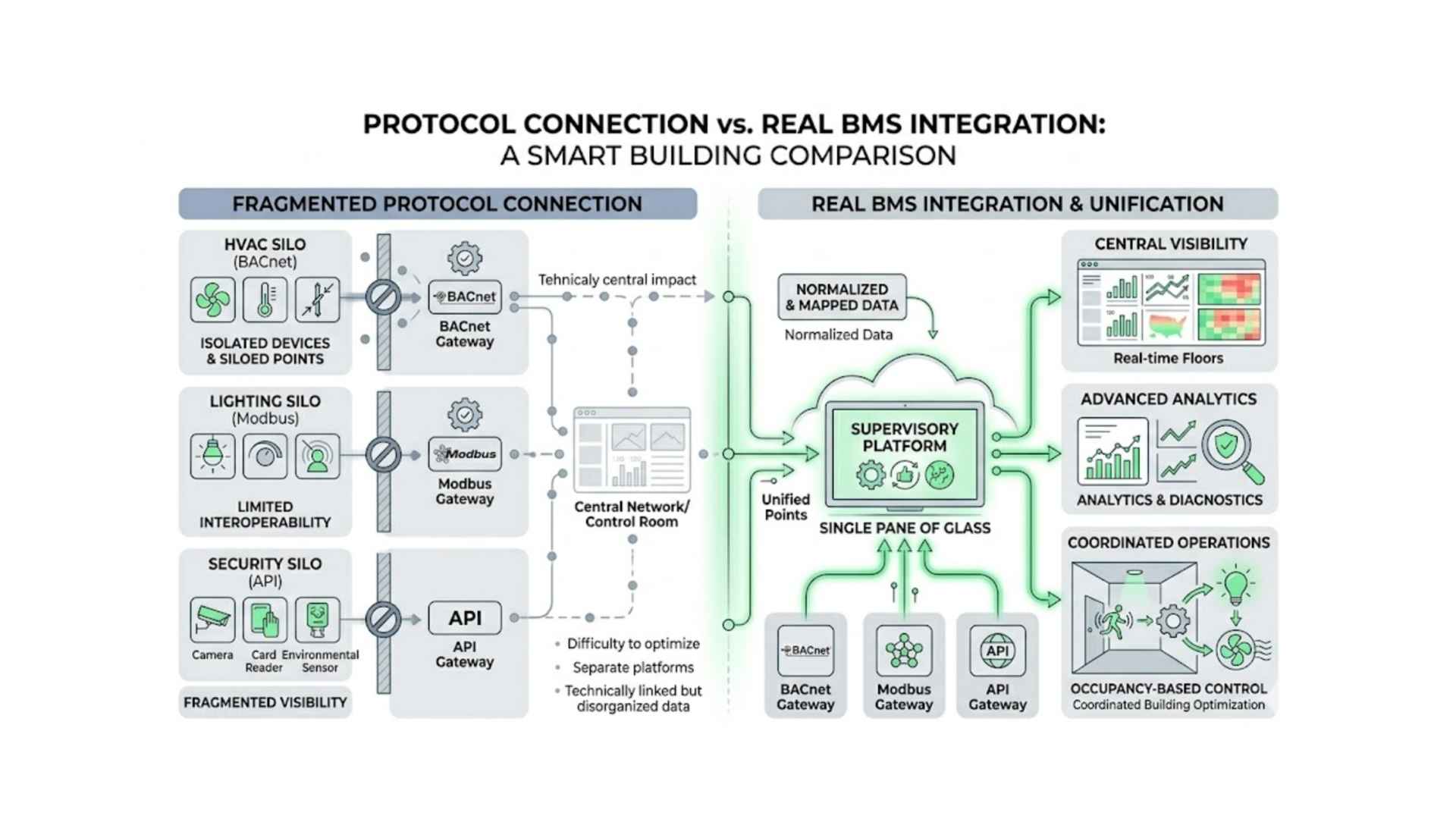
HVAC has its own controls. Meters live somewhere else. Lighting has another interface. Access control, IAQ, occupancy, and energy data all sit in different places. The building is technically automated, but operationally it still feels fragmented.
That is where BMS integration starts to matter.
In simple terms, BMS integration means connecting building systems, devices, and data sources into one usable operating environment so teams can monitor, control, analyze, and improve the building more coherently. ASHRAE’s latest Guideline 13 frames BAS design around system architecture, communication, testing, documentation, performance monitoring, and even guidance for legacy control systems, which shows that integration is not a side topic. It is part of the core building-controls discipline.
 It is not just protocol conversion
 It is not just protocol conversion
This is the first thing worth clearing up.
A lot of people reduce BMS integration to “connect BACnet and Modbus.” That is part of the job, but not the whole job. Real BMS integration is about making systems useful together, not just technically reachable. The U.S. Department of Energy (DOE) describes its interoperability work as a way to enable the rapid, cost-effective integration of building automation systems by exposing sensors, actuators, and other data sources through a uniform software interface. That is a much better definition of what the market is trying to achieve.
So yes, protocols matter. But the real goal is bigger:
- unify data from multiple systems
- normalize how points are understood
- make control and monitoring more consistent
- reduce engineering friction
- create a stronger base for analytics, unlocking energy efficiency, and remote operations
That is why BMS integration is really about platform-level integration, not just wiring two products together.
What usually gets integrated into a BMS
In real projects, BMS integration often includes more than HVAC.
BACnet is specifically designed to integrate products and services made by different manufacturers across HVAC, lighting, fire and life safety, and access control. ASHRAE’s BACnet FAQ also notes that BACnet now includes a secure web-services-based interface for integrating data from disparate, protocol-independent sources. That tells you something important: modern BMS integration is expected to cross both vendor and system boundaries.
A practical BMS integration layer often brings together:
- smart HVAC controls and equipment points
- lighting controls
- submeters and energy data
- indoor air quality sensors
- occupancy-based HVAC control systems
- access-control signals
- alarms and maintenance events
- cloud platforms and reporting tools
That is why the strongest projects do not treat integration as a one-time technical task. They treat it as the foundation for better building operations.
Why it becomes difficult in existing buildings
 Why it becomes difficult in existing buildings
This is where the topic gets real.
In a new building, integration can be designed early. In existing buildings, it is usually messier. Systems were installed at different times. Vendors changed. Naming conventions drifted. Documentation is incomplete. Some points are available, some are not. And the BMS was often never designed to become a modern cloud BMS as integration target later on.
ASHRAE Guideline 13 explicitly includes guidance for legacy control systems, while DOE’s interoperability work focuses on discovery, mapping, and reducing the cost of bringing older systems into a more uniform control environment. That is exactly why integration remains one of the biggest bottlenecks in modernization, often revealing critical building-operations blind spots.
This is also why many integration projects are really integrated retrofits. The goal is usually not to rip everything out. It is to connect what already exists well enough to make the building more visible, more manageable, and more scalable, which is how we approach converting infrastructure from legacy to smart infrastructure.
How modern BMS integration usually works
A practical integration architecture often looks something like this:
- System layer: Existing HVAC, lighting, meters, sensors, and other building systems stay where they are.
- Protocol / gateway layer: Gateways or edge devices communicate with systems through protocols like BACnet, Modbus, KNX, MQTT, or vendor APIs.
- Data / normalization layer: Points are mapped, named, and structured so different systems can be understood consistently.
- Supervisory layer: The integrated data then lands inside the BMS, analytics platform, or cloud environment where operators can use it.
Modern deployment architectures regularly use compact hardware like a Raspberry Pi edge AI system to handle protocol translation at the property line. Furthermore, enterprise ecosystems streamline these supervisory workflows through certified software pathways, such as the Niagara Pro Cloud integration frameworks or direct data pipelines leading into Building X integration profiles.
That is why BMS integration is closely tied to both legacy BAS systems and cloud-based operating layers. In many buildings, integration is the bridge between the old control environment and the newer digital layer the team actually wants to use.
Why open protocols matter so much
A building becomes much easier to modernize when it is not locked into one vendor’s private language.
BACnet remains one of the most important open integration standards in this space. ASHRAE states that BACnet is designed to provide a platform to integrate building control products and services from different manufacturers, and BACnet International continues to describe it as the de facto communications protocol for interoperability within BMS and building automation environments.
That does not mean BACnet solves everything by itself. But it does explain why BMS integration conversations almost always lead back to interoperability, gateways, object models, and how easily systems can be discovered and mapped to enable dynamic HVAC optimization loops. DOE’s self-mapping work is basically trying to make that process faster, cheaper, and less custom every time.
Why cybersecurity is now part of BMS integration
This is another reason integration is more serious than it used to be.
Once systems are connected across more vendors, more networks, and more off-site services, cybersecurity becomes part of the integration architecture. ASHRAE’s new Managed BACnet guidance is built around interoperable management of network and security functions in BACnet systems, including interfaces to IT systems, cloud services, gateways, and multi-site management. It specifically describes BACnet/SC functional roles, secure gateways, and local plus global management models.
That is a good reminder that modern BMS integration is not just about “making the data show up.” It is also about making the system manageable, secure, and sustainable over time.
What good BMS integration looks like now
The better projects usually share a few traits:
- They start with operational use cases, not just protocol checklists.
- They define which systems really need to work together and why (such as tracking the top 7 facility management KPIs via unified telemetry).
- They prefer open, discoverable interfaces where possible.
- They treat naming, mapping, and point quality as real work, not afterthoughts.
- They think early about cybersecurity, remote access, and long-term maintainability.
And most importantly, they use integration to make the building simpler for operators, not more complicated.
That is why BMS integration fits inside a broader smart building platform story—if integration is done well, it becomes easier to add analytics, fault detection, occupancy logic, energy reporting, and portfolio-wide visibility later. If it is done badly, every future improvement becomes slower and more expensive.
Final thought
 Final thought
BMS integration is really about one thing: making building systems useful together.
Not just connected. Not just visible. Useful.
That is why it matters so much in existing buildings. Once systems are integrated properly, the building starts to act less like a collection of disconnected tools and more like one operating system. That creates the base for a modern cloud BMS as integration target, for deep analytics, for remote operations, and for the kind of automated ecosystem that operators now expect from a serious building platform.
In other words, BMS integration is not the finish line. It is the layer that makes the rest of modernization possible.
