


⚡ Quick Summary
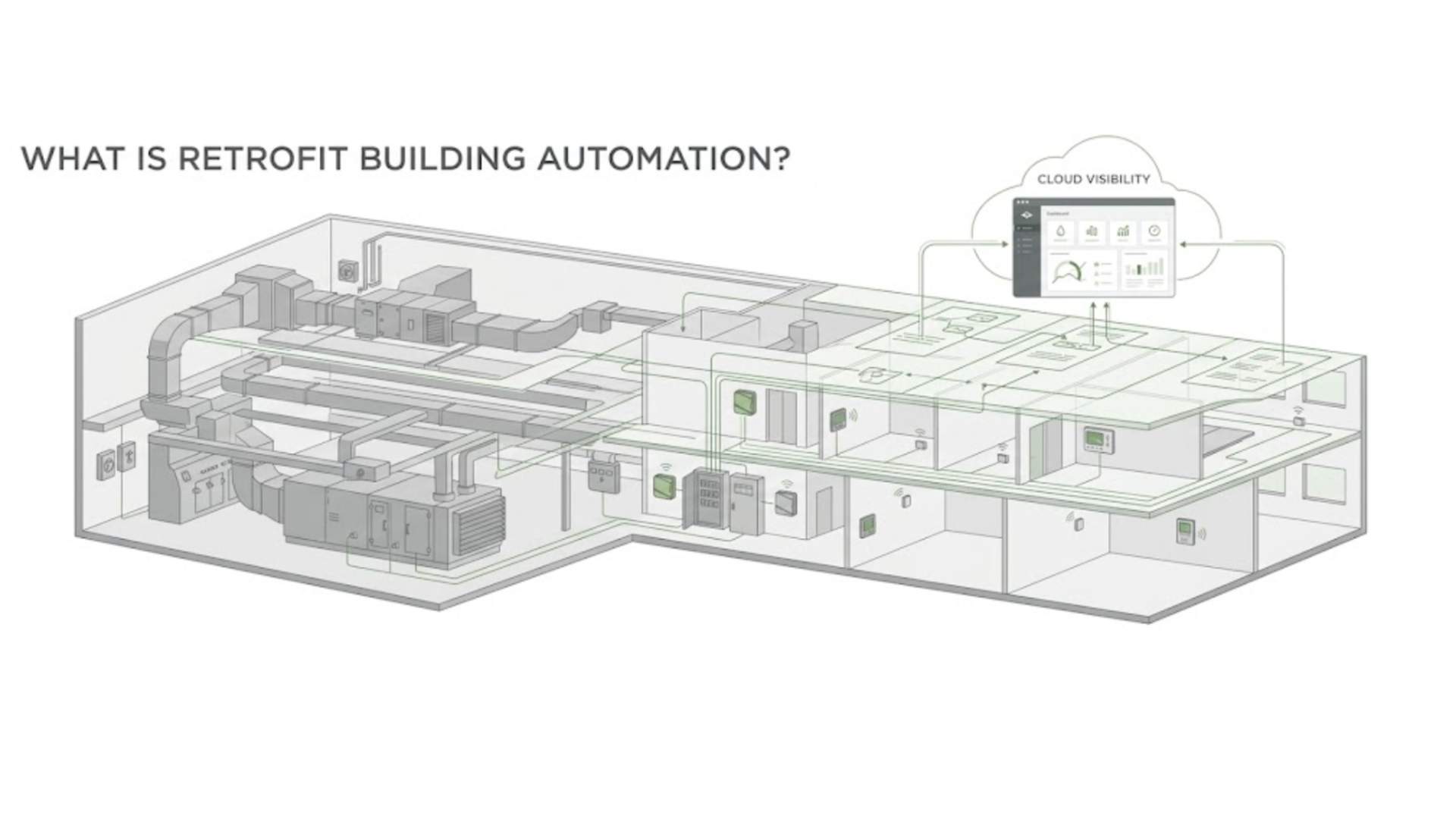
Retrofit building automation means upgrading an existing building with better sensing, controls, integration, and supervisory logic without rebuilding everything from scratch. Instead of ripping out functional equipment, it layers smarter control onto what is already there.
A typical retrofit adds:
- Sensing: room level temperature, humidity, CO2, and occupancy data the old system never captured
- Controls: smarter setpoints, schedules, and equipment logic
- Integration: connecting fragmented HVAC, metering, lighting, and IAQ systems
- Supervisory layer: cloud dashboards, alarms, analytics, and remote access
Why it matters: The building challenge is overwhelmingly an existing stock challenge. Buildings account for about 30 percent of global final energy use and 26 percent of energy related emissions, and the IEA and GlobalABC estimate around 20 percent of existing stock must reach zero carbon ready level by 2030, a goal new construction alone cannot meet.
Most buildings do not start from zero.
They already have HVAC equipment, local controllers, meters, schedules, alarms, and some level of building logic. The real problem is usually not the total absence of systems. It is that the systems are old, fragmented, hard to access, or too limited for today’s operational needs. That is where retrofit building automation starts to matter. In simple terms, retrofit building automation means upgrading an existing building with better sensing, controls, integration, and supervisory logic without rebuilding everything from scratch. It is one of the most practical ways to improve performance in existing buildings because the global building challenge is overwhelmingly an existing-stock challenge, not just a new-construction challenge. Buildings operations account for about 30% of global final energy consumption and 26% of global energy-related emissions, and both the IEA and GlobalABC say around 20% of the existing building stock needs to be renovated to zero-carbon-ready level by 2030.
Why retrofit matters so much now
This is the first thing worth understanding: the world is not going to solve building performance by replacing everything with brand-new smart buildings.
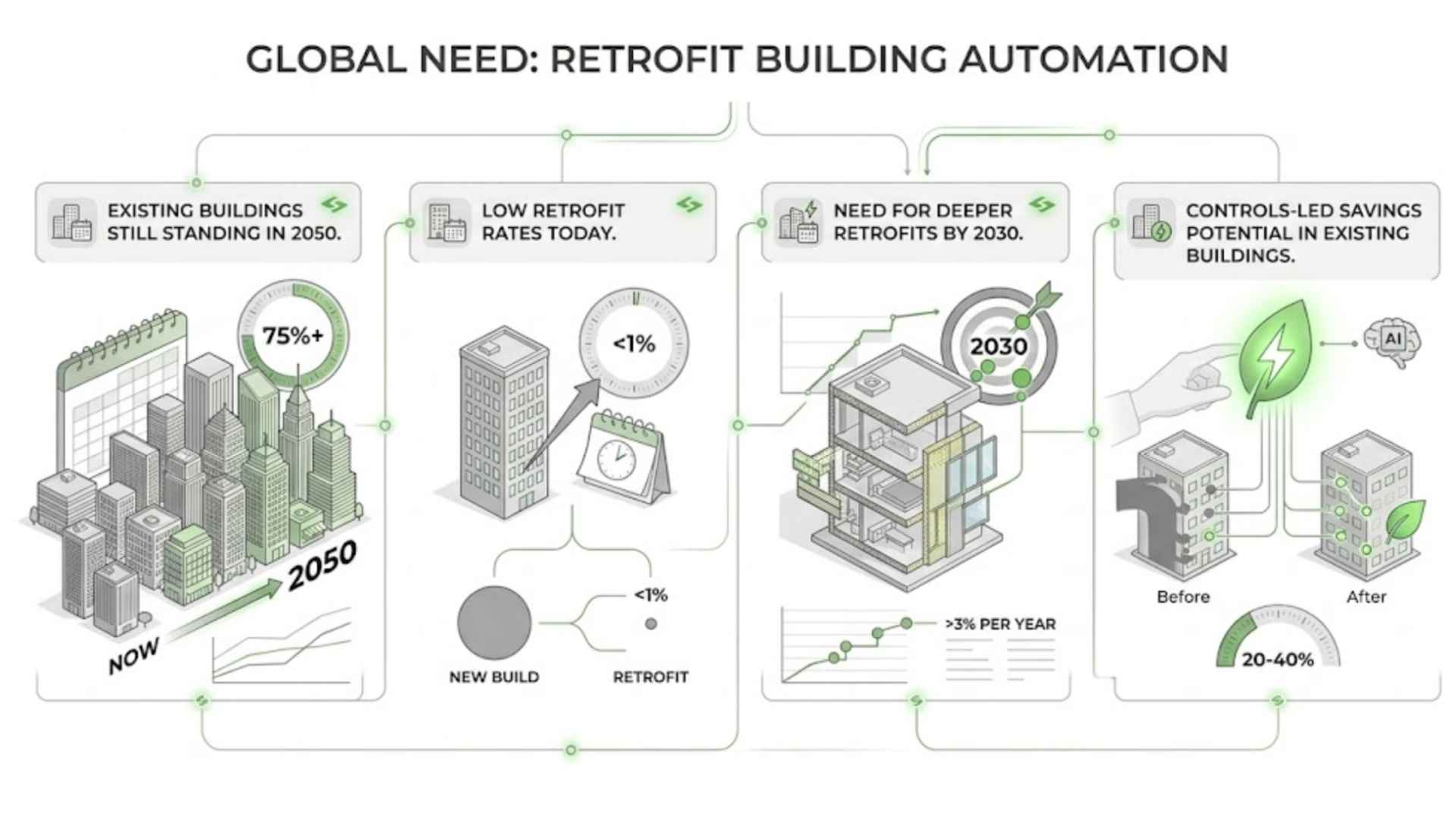
WorldGBC says half of the buildings that will exist in 2050 already exist today. In Europe, the challenge is even more obvious. The European Commission says 85% of EU buildings were built before 2000, 75% have poor energy performance, and the annual renovation rate is still only 1%. The EU’s Renovation Wave adds that 85% to 95% of today’s buildings will still be standing in 2050. In developed economies more broadly, the IEA says at least 40% of building floor area was built before 1980. So retrofit building automation is not a side topic. It is one of the main ways existing buildings can become easier to operate, cheaper to run, and more aligned with decarbonization goals.
It is not the same as a full controls replacement
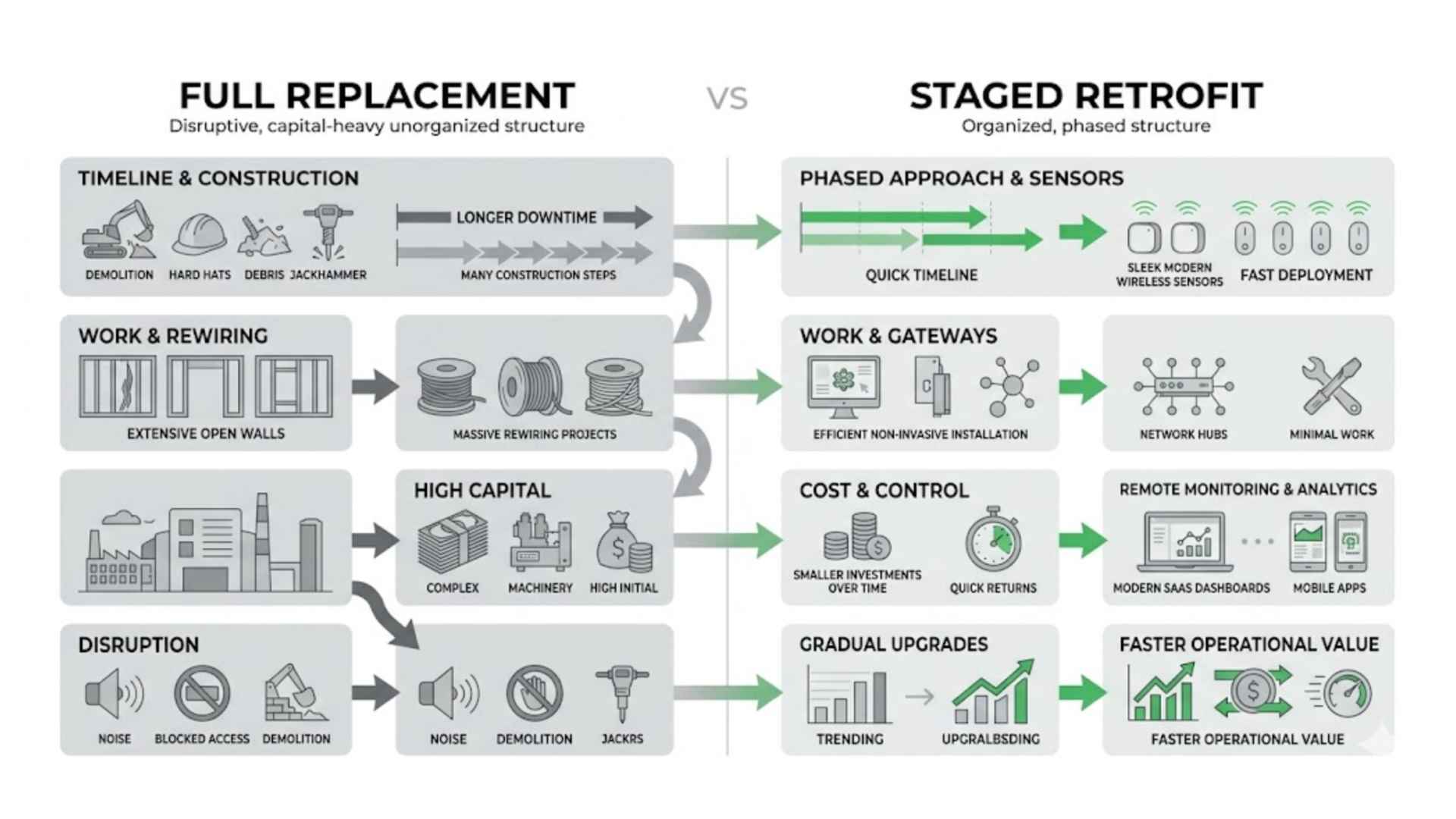
A lot of people hear “automation retrofit” and assume a painful rip-and-replace project.
That is often the wrong mental model. In many real buildings, retrofit automation is more selective. It may involve adding wireless room sensors, upgrading thermostats or zone controls, introducing new gateways, improving schedules, integrating existing HVAC into a modern cloud BMS as integration target, or layering analytics and remote visibility on top of what is already there. The goal is not always to tear out the legacy BAS systems. Very often, it is to make them more usable. DOE’s building-controls work is moving in exactly this direction: lower-cost controls, easier system discovery, better interoperability, and scalable supervisory layers that reduce engineering friction.
Why the cost perspective matters
Retrofit decisions are rarely made on technical potential alone. They are made on disruption, payback, downtime risk, and how much value can be captured before capital budgets run out.
That is why retrofit automation is attractive. Compared with full mechanical replacement, controls-led retrofits often target faster wins: better scheduling, improved zone visibility, smarter ventilation logic, fault detection, remote monitoring, and more responsive room-level control. DOE says that low-cost sensors and controls along with retrofit building automation systems can reduce building energy consumption by 20% to 30% in the existing stock of small and medium-sized U.S. commercial buildings, representing 0.3 to 0.4 quads of total energy savings. The same DOE source also notes that over 90% of U.S. commercial buildings are small or medium-sized and have little or no whole-building automation systems. That is a strong reminder that cost-effective retrofit automation is not just for trophy towers. It is a very large operational market.
There is also a financing reality here. The IEA notes that one of the biggest barriers to getting buildings on track is upfront cost, especially compared with lower-efficiency or fossil-fuel-based alternatives. That is exactly why retrofit building automation matters operationally: it lets teams phase modernization instead of betting everything on one giant project. In many buildings, remote building monitoring comes first, then controls tuning, then equipment integration, then more advanced optimization.
What retrofit building automation usually includes
In practice, retrofit building automation is often built in layers.
It might start with better field visibility: room temperature, humidity, CO2, occupancy, or energy points that the building did not have before. Then it adds integration: existing HVAC, meters, lighting, or IAQ devices connected into one operating layer. Then it adds supervisory functions: alarms, trends, rules, setpoint governance, and portfolio visibility. After that, the building is finally in a position to support things like FDD, demand-controlled ventilation, occupancy-based HVAC control, and smarter optimization logic. That is why retrofit building automation usually sits between BMS integration, a wireless BMS approach, and a broader smart building platform. It is the practical path that turns old infrastructure into something operationally modern.
The operational case is often stronger than the pure energy case
Energy savings matter, but operators usually feel the pain somewhere else first.
The building is hard to manage. Complaints repeat. Schedules drift. Faults are not obvious. Teams have to go onsite too often. Data sits in five places. Comfort is inconsistent across zones. Automation retrofits fix these day-to-day problems by making the building more legible and more controllable. That is why the best projects are not sold only as “efficiency upgrades.” They are sold as operational upgrades that also reduce waste. DOE’s controls roundtable makes a related point from the market side: even when control projects save energy, operators can unintentionally erase those savings if systems are too complex or too hard to trust. Simpler, more usable control architecture matters.
The global retrofit need is not the same everywhere
This is where the worldwide picture gets more interesting.
Globally, the average retrofit rate is still around 1% per year, and those retrofits typically deliver less than 15% average energy-intensity reduction. The IEA says retrofit rates need to jump to at least 2.5% by 2030, and the GlobalABC report suggests 2.5% to 5% or more may be needed with more extensive retrofits. At the same time, the global building story is split. In emerging markets, the IEA says global floor area is expected to grow by around 15% by 2030, with around 80% of that growth in emerging market and developing economies. So globally, the mission is two-sided: retrofit the existing stock fast enough, while also preventing the next wave of buildings from locking in poor performance.
Regional examples make the case even clearer. In the Arab region, GlobalABC says buildings and construction had a 30% share of total primary energy supply and 23% of total final energy consumption in 2019, and that large-scale retrofits could reduce total final energy consumption by 30% by 2050. That is a major operational and economic signal for countries dealing with high cooling demand, fast urbanization, and long-lived building stock.
What good retrofit automation looks like now
The strongest projects usually do three things well.
First, they avoid “all-at-once” thinking. They prioritize the layers with the fastest operational return: sensing gaps, schedules, supervisory visibility, integration, and remote access.
Second, they modernize around the building that exists, not the one the spec sheet wishes existed. That often means wireless retrofits for existing buildings, staged integration, and selective controller upgrades rather than full replacement.
Third, they connect automation upgrades to real use cases: HVAC optimization, IAQ monitoring, occupancy-based control, fault detection, and better portfolio operations. That is how retrofit building automation stops being a technical exercise and starts becoming a business case. DOE’s own framing of advanced building control solutions is very close to this: low-cost sensors and controls as enablers for better comfort, efficiency, and smarter building operation on existing stock.
Final thought
Retrofit building automation is really about one thing:
getting more value out of the building that is already there.
Not by pretending it is brand new.
Not by replacing everything at once.
But by adding the layers of control, visibility, and integration that make existing buildings easier to run and easier to improve.
That is why the topic matters so much now. The numbers are clear: the stock is already here, the retrofit rate is too low, and the operational upside is too large to ignore. In many buildings, retrofit automation is not the second-best option. It is the realistic modernization path.
