


⚡ Quick Summary
Weather based HVAC optimization means adjusting HVAC operation based on real outdoor conditions such as temperature, humidity, wet bulb, solar load, and short term forecasts, instead of relying only on fixed schedules and static setpoints. It lets a building run differently on a mild morning than on a hot, humid afternoon.
It is broader than a simple outdoor temperature lockout:
- Optimal start and stop: start late and stop early based on outdoor conditions so the building coasts
- Economizer logic: use cool outside air for free cooling when conditions allow
- Supply air and water temperature reset: adjust setpoints to outdoor conditions
- Ventilation adjustments: respond to humidity and outdoor air quality
Why it matters: Building loads are strongly weather dependent, yet most controls are still schedule driven. Aligning operation with actual conditions cuts energy waste while maintaining comfort and ventilation performance. Sensgreen’s Energy Management solution is built around this principle., in line with DOE guidance and ASHRAE Guideline 36.
A lot of HVAC systems still behave as if every day is the same.
They start at the same time, stop at the same time, and run with the same assumptions whether it is mild outside, brutally hot, unusually humid, or somewhere in between. That is exactly what weather-based HVAC optimization tries to fix. In simple terms, it means adjusting HVAC operation based on real outdoor conditions such as temperature, wet-bulb, humidity, solar impact, and sometimes short-term weather forecasts, instead of relying only on fixed schedules and static setpoints. DOE’s commercial-building guidance explicitly points to weather-responsive strategies such as optimal start/stop based on indoor and outdoor conditions and condenser-water temperature reset based on outside-air wet-bulb temperature, while ASHRAE’s current Guideline 36 framework centers on high-performance sequences designed to reduce energy use while maintaining comfort and ventilation performance.
It is not just “check the outdoor temperature”
That is the first thing worth clearing up.
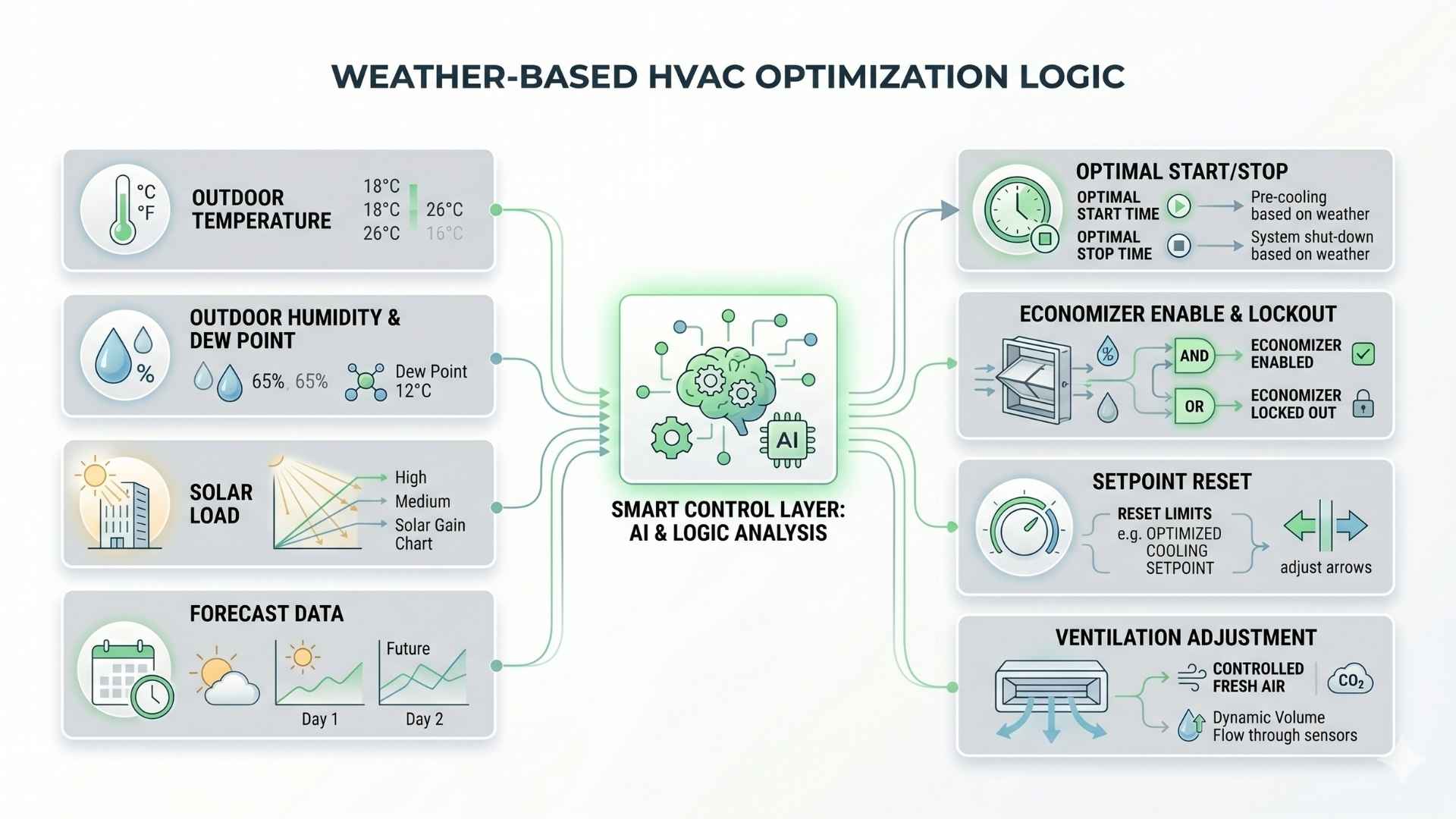
Weather-based HVAC optimization is broader than a simple outdoor-air temperature lockout. In practice, it can include optimal start and stop, economizer enable and disable logic, supply-air or water-temperature reset, ventilation adjustments, and more advanced supervisory control that reacts differently on a mild morning than on a high-humidity afternoon. DOE’s controls literature and PNNL’s controls-impact study both treat optimal start/stop and outdoor-condition-based reset as meaningful control measures, not minor tweaks. PNNL specifically describes optimal stop as shutting an AHU down early so the building can coast, with the stop time controlled by outdoor-air temperature.
Why it matters in real buildings
The reason this matters is simple: building loads are strongly weather-dependent, but many control strategies are still schedule-dependent.
On mild days, HVAC systems often start too early and run harder than needed. On extreme days, a building may need earlier pre-conditioning, different reset logic, or tighter humidity handling. DOE’s Asset Score guidance says optimal start can save energy and reduce wear because the system does not need to start as early during mild weather, and PNNL’s control study shows that optimal-stop logic is most feasible when outdoor conditions are closer to the building’s balance point. In other words, weather-based optimization matters because the right HVAC move at 7:00 a.m. in October is not the right move at 7:00 a.m. in August.
What weather-based HVAC optimization usually includes
The practical building version of this usually comes down to a few control moves.
Optimal start and stop uses indoor and outdoor conditions to decide when the building should begin recovery and when it can stop early. DOE recommends this as an operational measure for major air-conditioning systems.
Weather-based reset changes operating targets based on outdoor conditions. DOE’s guidance specifically calls out condenser-water temperature reset based on outside-air wet-bulb temperature as an energy-saving opportunity. ASHRAE guidance also notes that strategies such as supply-air-temperature reset and hydronic-water reset can work well, but should be applied carefully because humidity and comfort can suffer if the reset logic is too aggressive.
Economizer logic uses outdoor air for “free cooling” when conditions are favorable. PNNL’s advanced rooftop-control field work treats economizer control as one of the core smart HVAC controls measures, alongside optimal start/stop and DCV.
Forecast-aware supervisory control is the newer layer. Research on model predictive control has shown that using weather forecasts can improve HVAC energy efficiency while maintaining comfort, and a 2025 Berkeley office-building field study showed MPC being used in a real commercial building to support both HVAC demand flexibility and cost savings.
What good practice looks like now
The better projects do not use weather as a standalone signal. They combine weather with building response.
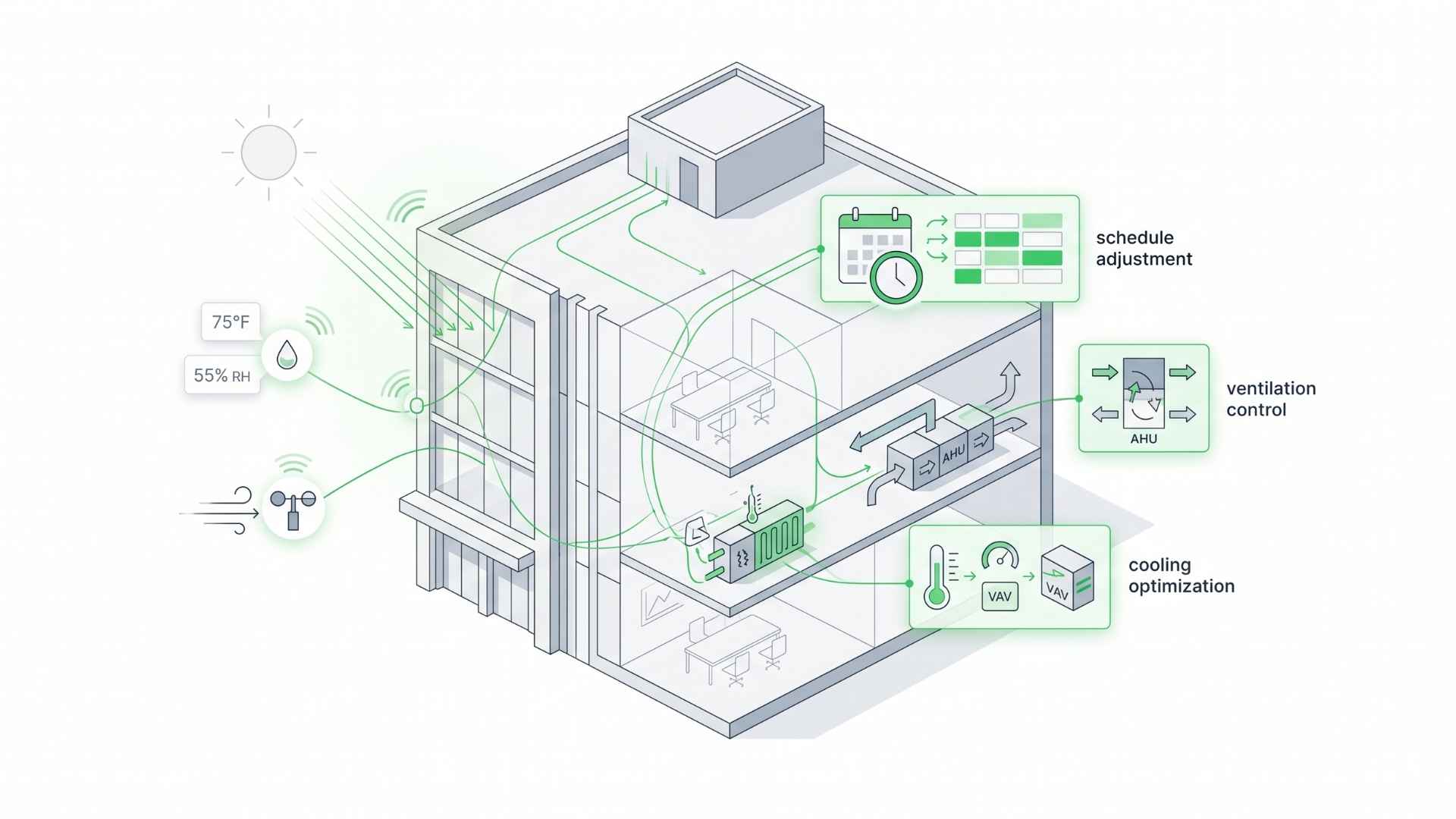
That means outdoor conditions should influence HVAC logic, but not override common sense. A good control layer still checks indoor temperature, humidity, occupancy, and sometimes IAQ before deciding what to do. ASHRAE’s message in Guideline 36 is important here: high-performance sequences work because they are structured, standardized, and designed to balance energy, comfort, and ventilation rather than chasing one variable in isolation. That is also why weather-based optimization works best as part of a broader smart-HVAC strategy, not as a single clever rule added on top of weak controls.
Where teams usually get it wrong
A common mistake is using dry-bulb temperature alone for everything.
That can work in simple cases, but it breaks down quickly when humidity matters. Another mistake is pushing reset strategies too far without watching comfort or latent load. ASHRAE explicitly warns that supply-air-temperature reset and hydronic reset can produce undesired impacts on temperature and especially humidity if they are applied carelessly. That is the real lesson: weather-based optimization is not about making the system more aggressive. It is about making it more situationally intelligent.
Extreme climates like the GCC need a different mindset
This matters even more in the Gulf.
The UAE and much of the GCC sit in a hot desert climate zone, but the story is not just “very high temperature.” Coastal conditions are heavily shaped by proximity to the Arabian Gulf and Gulf of Oman, which brings high summer humidity on top of the heat. An official UAE climate report notes that coastal summer temperatures can reach about 48°C with humidity levels as high as 90%, while interior desert regions can climb to 50°C. More recent climate literature also describes the UAE as arid to hyper-arid, with strong coastal-versus-inland variation and rising heat stress over time.
That changes what “weather-based optimization” should mean.
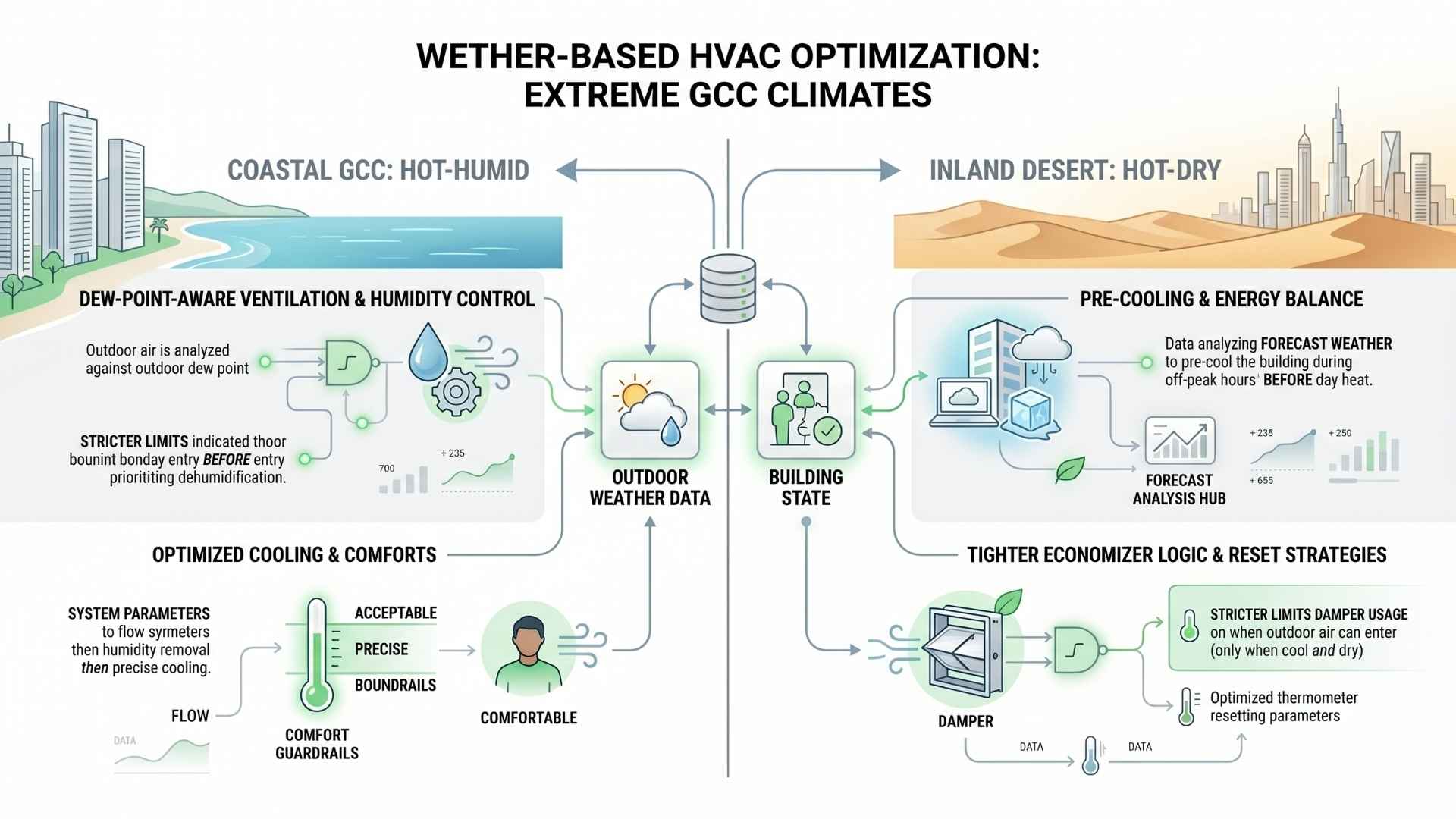
In a mild European climate, weather-based control might focus heavily on start/stop, free cooling, and seasonal resets. In GCC conditions, it has to care much more about latent load, dew point, and outdoor-air treatment. That is why outdoor-air strategies should not be driven by dry-bulb alone in hot coastal Gulf cities. DOE’s dedicated-outdoor-air-system definition is built around the ability to dehumidify ventilation air to a 55°F dew point, which is a reminder that ventilation air is often a moisture problem as much as a temperature problem. In practice, that means GCC buildings often need weather-based logic that pays close attention to wet-bulb or dew point, not just outdoor temperature.
A practical GCC playbook
For extreme climates like the GCC, the smarter sequence usually looks something like this:
Use weather-based pre-cooling in the morning when it helps reduce peak load, but do not let it create unnecessary moisture problems later in the day. Use humidity-aware ventilation control, especially in coastal conditions where bringing in outdoor air can sharply increase latent load. Use reset strategies with guardrails, so chilled-water, condenser-water, or supply-air adjustments do not quietly damage comfort or humidity control. And be realistic about economizer hours: in long hot and humid seasons, the number of truly favorable outdoor-air windows is often limited, so economizer logic needs tighter enable/lockout rules than in milder climates. Those principles follow directly from DOE’s outdoor-condition-based reset guidance, ASHRAE’s caution on humidity impacts, and the GCC/UAE climate realities described in official climate sources.
Final thought
Weather-based HVAC optimization is really about one thing:
making HVAC respond to the day it is actually operating in. For a broader framework, see our building energy management guide. Equipment like smart AC and radiator control systems benefit directly from this approach.
Sometimes that means starting later because the morning is mild. Sometimes it means stopping earlier because the building can coast. Sometimes it means resetting plant temperatures based on outdoor wet-bulb. And in places like the GCC, it often means respecting the fact that extreme heat and humidity are not edge cases. They are the operating reality. Weather-based optimization works best when it treats outdoor conditions as a live control input, not background information. This is where BMS integration plays a key role in enabling the data flow.
