

⚡ Quick Summary
Thermal comfort is the condition in which people feel satisfied with the thermal environment, and it depends on far more than the thermostat reading. ASHRAE Standard 55 aims for conditions acceptable to a substantial majority (typically 80 percent or more) of occupants.
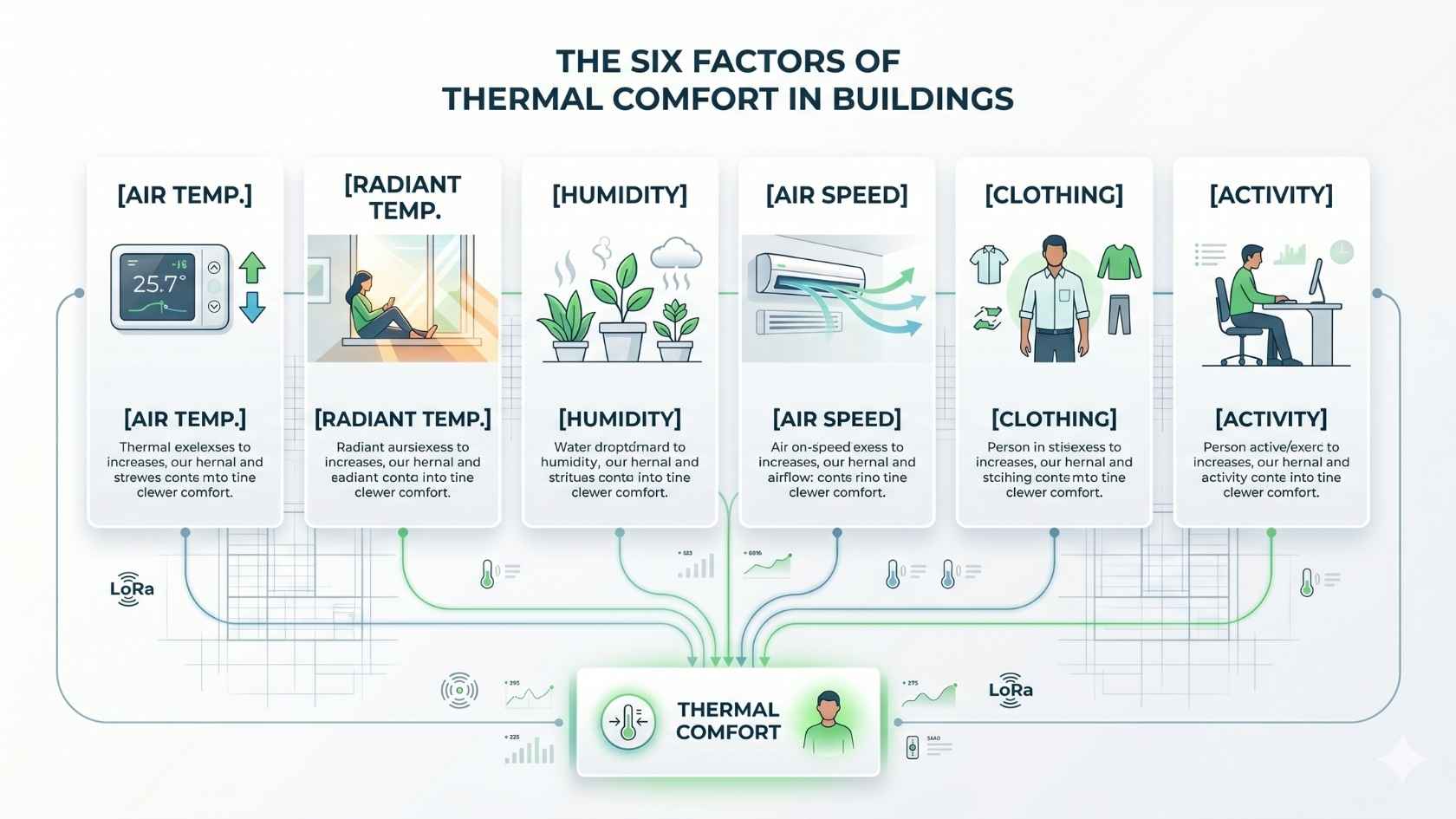
ASHRAE’s framework is built around six factors:
- Air temperature
- Radiant temperature (heat from surfaces such as sunlit facades)
- Humidity
- Air speed
- Clothing level (personal)
- Activity level (personal)
Why it matters: Because four environmental and two personal factors interact, two people in the same on setpoint room can feel very differently. Delivering real comfort means sensing and controlling the full balance, not chasing a single temperature number.
Thermal comfort sounds simple until you try to deliver it in a real building.
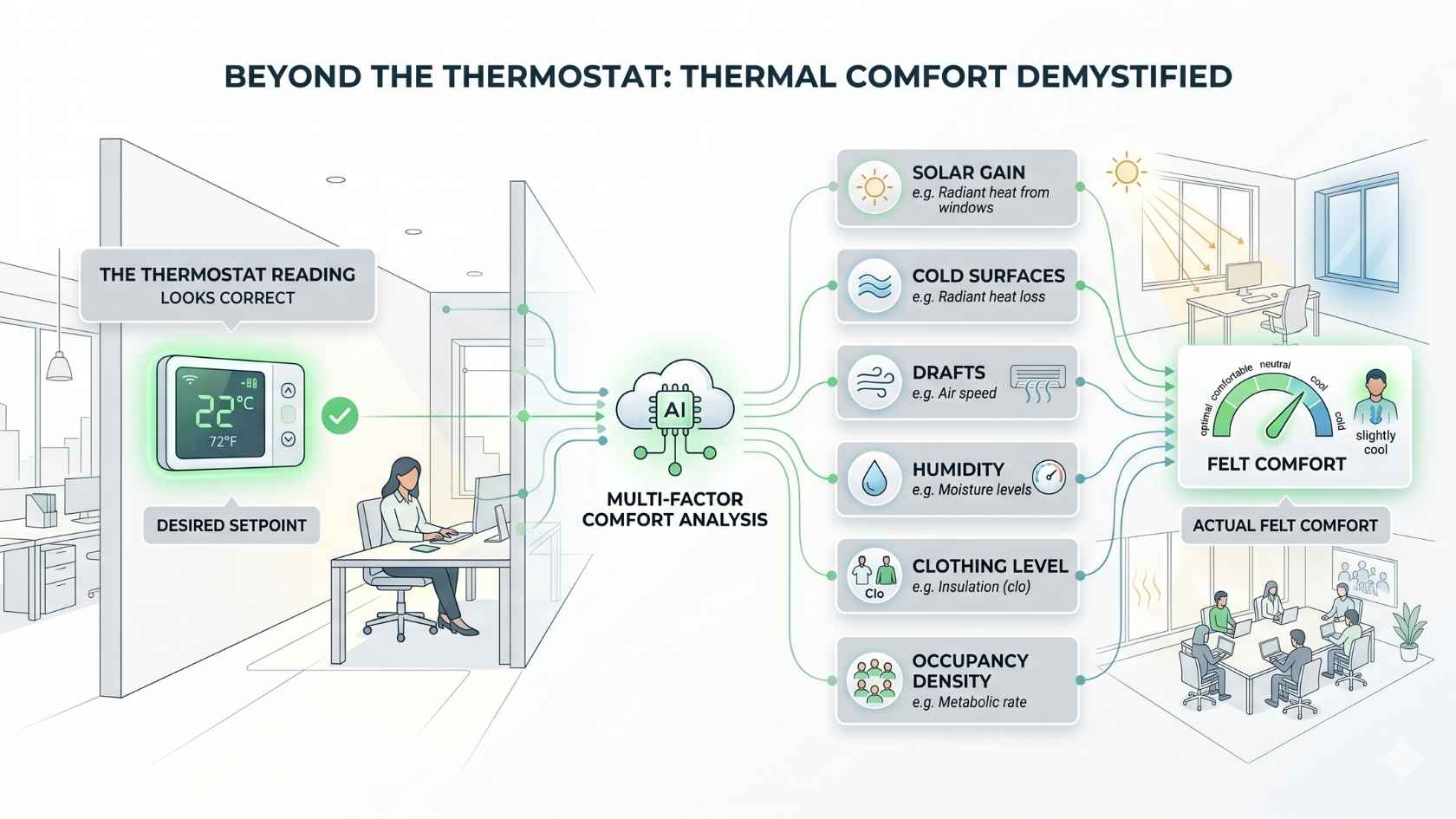
Most teams start with temperature. But in practice, comfort is rarely just about whether the thermostat says 22°C. People can feel too warm in a room that looks “on setpoint,” or too cold in a space that is technically within range. That is because thermal comfort depends on more than air temperature alone. ASHRAE Standard 55-2023 defines acceptable thermal conditions using a mix of environmental and personal factors, and its goal is conditions acceptable to a substantial majority of occupants, typically 80% or more.
In simple terms, thermal comfort in buildings means the condition in which people feel satisfied with the thermal environment. ISO 7730:2025 describes it as the evaluation of general thermal comfort and thermal dissatisfaction in moderate thermal environments. In other words, comfort is not a single number. It is a balance.
It is not just about room temperature
This is the first thing worth clearing up.
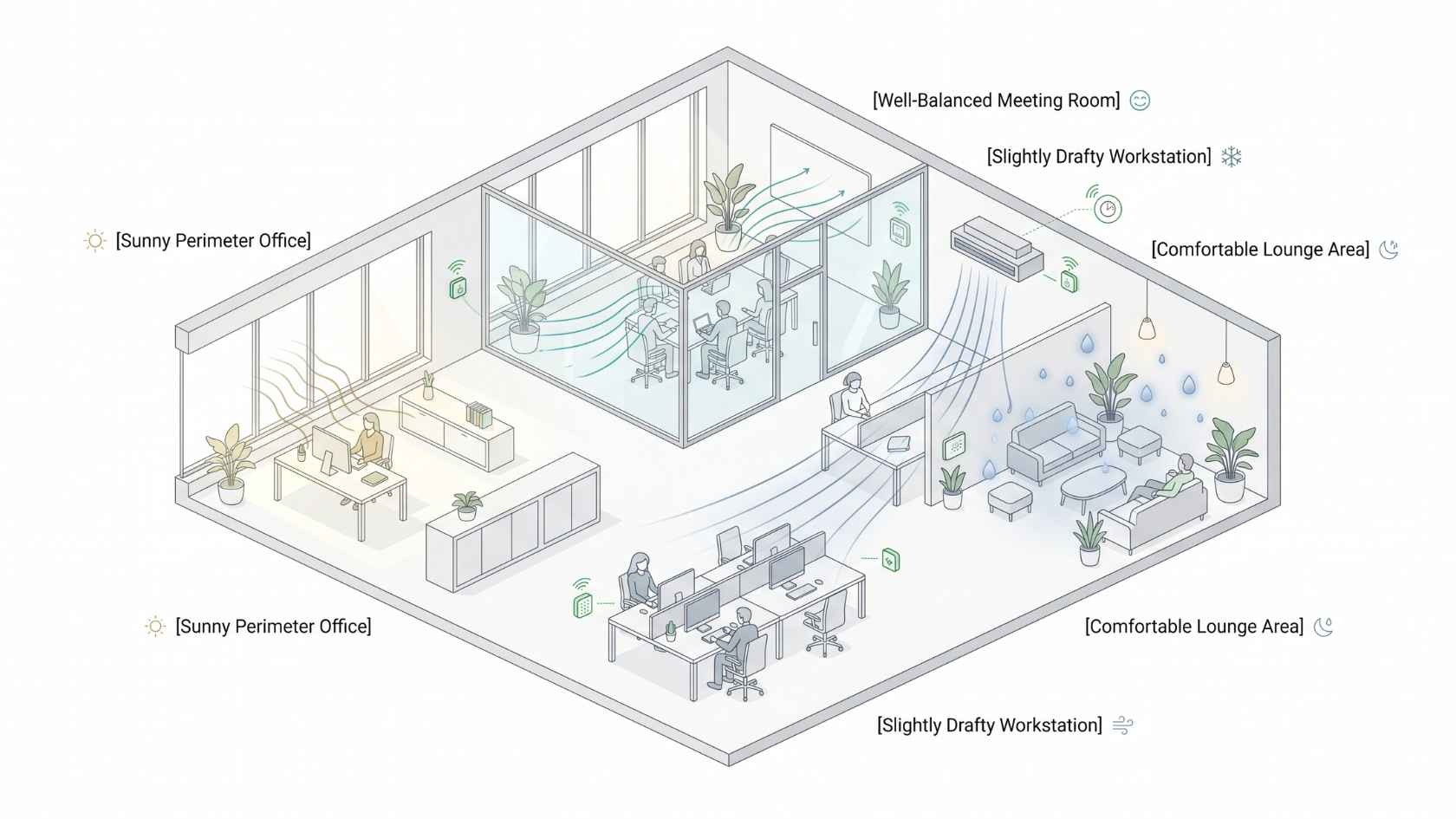
ASHRAE’s thermal comfort framework is built around six primary factors. Four are environmental: air temperature, radiant temperature, humidity, and air speed. Two are personal: clothing and activity level. That is why two people in the same room can have very different comfort reactions, especially if one is moving more, dressed differently, or sitting near a warm facade or a cold draft.
This also explains why “just lower the setpoint” is often the wrong response to comfort complaints. If the real problem is glare-driven radiant heat, poor air movement, a cold window surface, or a badly balanced zone, changing the setpoint alone can make the building use more energy without actually making people more comfortable. That is exactly why thermal comfort should be treated as an operational topic, not just a thermostat topic.
The factors that actually shape comfort
A practical way to understand thermal comfort is to break it into the things building teams can see and influence.
Air temperature is the obvious one, but it is only part of the picture.
Mean radiant temperature often gets ignored, even though it matters a lot. If a person sits near a hot facade, a sunny window, or a cold surface, they may feel uncomfortable even when the air temperature looks fine. ASHRAE explicitly includes thermal radiation in its comfort model for this reason.
Air speed can help or hurt. In warm conditions, controlled air movement can improve comfort. In other cases, drafts can create local discomfort. ASHRAE 55-2023 also includes updated guidance on local discomfort, including vertical temperature gradients between head and ankle level.
Humidity matters too, though often less directly than people think. Humidity alone does not define comfort, but it affects how warm or stuffy a space feels and how the body sheds heat.
Then there are the personal factors: clothing and metabolic rate. A person in business clothes sitting still has different comfort needs from a person moving around in light clothing. That sounds obvious, but it is one reason “one setpoint for everyone” rarely performs perfectly in real buildings.
Why thermal comfort is a bigger issue now
Comfort is getting harder, not easier.
Buildings are becoming more airtight and more energy efficient, which is good in many ways, but it also means overheating, solar gain, and poor seasonal control can become more visible if design and operations do not keep up. CIBSE explicitly treats overheating as a growing health and wellbeing issue and uses the adaptive thermal model in TM52 to assess overheating risk in buildings.
There is also a shift in expectations. Occupants increasingly expect buildings to feel stable, responsive, and healthy. They are less tolerant of spaces that swing between too cold and too warm, especially in offices, hospitality, education, and premium commercial spaces. That is part of why thermal comfort is no longer just a design-stage checkbox. It has become an ongoing operating concern.
The two main ways comfort is evaluated today
In practice, there are two big comfort models that show up most often.
The first is the PMV/PPD approach, used in standards like ISO 7730 and parts of ASHRAE 55. This is more analytical and is useful in mechanically conditioned buildings, where teams are trying to predict average thermal sensation and likely dissatisfaction.
The second is the adaptive comfort model, which is especially important in naturally ventilated or free-running buildings. CIBSE explains that adaptive comfort is based on the idea that people’s expectations and preferences are influenced by recent outdoor temperatures and by how much control they have over their environment, such as opening windows.
That difference matters. In a tightly controlled office with mechanical cooling, comfort is usually managed differently from a naturally ventilated school or mixed-mode building. Good teams do not use the same comfort logic everywhere.
What comfort problems look like in real buildings
In the field, thermal discomfort usually shows up in familiar ways.
One room is always too warm in the afternoon.
A perimeter zone feels cold in winter mornings.
People complain about drafts near diffusers.
A meeting room gets stuffy and warm as it fills up.
A hotel room cools aggressively, but still never feels quite right.
An office floor keeps bouncing between complaints from different teams.
These issues are not always caused by undersized equipment. Often the real problem is a mix of poor zoning, weak control logic, solar load variation, ventilation imbalance, limited sensing, or over-simplified scheduling. That is why comfort work often overlaps with smart HVAC control, occupancy-based control, and IAQ strategy. In real buildings, comfort problems are usually system problems, not just temperature problems.
What good thermal comfort practice looks like now
The best current approach is more holistic than it used to be. Thermal comfort is now a core dimension of HVAC optimization, not just temperature control.
Good buildings monitor more than one comfort signal. Hardware like smart AC and radiator control units help deliver precise zone-level comfort. Temperature still matters, but stronger strategies also pay attention to humidity, air speed, solar exposure, occupancy patterns, and sometimes CO2 or zone-level ventilation behavior where stuffiness and thermal complaints overlap. ASHRAE and ISO both frame comfort as a multi-factor problem, not a single-point problem.
Good buildings also respect zone differences. Interior and perimeter spaces are not the same. A lobby, meeting room, guest room, and open office should not all be treated with identical assumptions.
And increasingly, good buildings use adaptive and occupant-aware control. That does not always mean advanced AI. Sometimes it just means better zoning, better scheduling, more appropriate air movement, and more realistic comfort targets. But the wider industry is clearly moving toward occupant-centric control logic rather than one-size-fits-all operation.
A practical way to think about thermal comfort
The most useful way to frame it is this:
Thermal comfort is not the temperature a building is producing. It is the thermal experience people are having.
That experience is shaped by:
- air temperature
- radiant effects
- air movement
- humidity
- clothing
- activity
- and how much control people feel they have
That is why buildings that look “fine” on a dashboard can still feel wrong on the floor. Comfort lives in the interaction between environment, people, and control.
Final thought
Thermal comfort in buildings is really about one thing:
helping people feel right in a space without forcing the building. For more on how this connects to workplace wellbeing, see why every employee needs a greener office to work harder than it should.
That means going beyond static setpoints. It means understanding zones, surfaces, airflow, and occupancy patterns. And it means accepting that comfort is not a single magic number.
The buildings that do this well are not always the ones with the lowest thermostat settings.
They are the ones that understand how comfort actually works.
